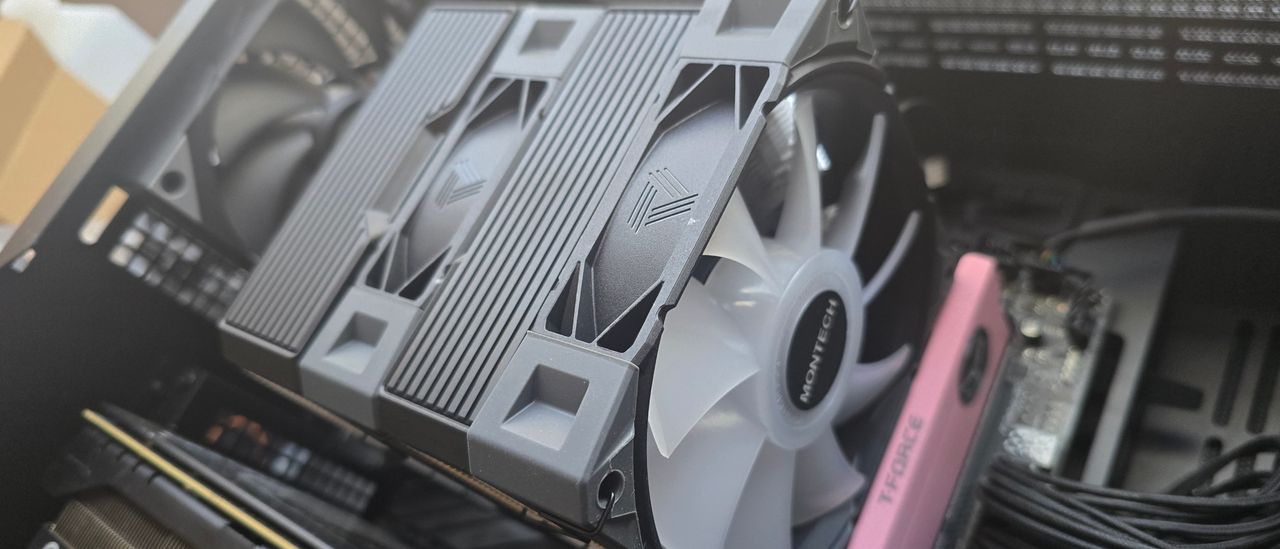
The Montech NX600 review introduces it without frills: a dual tower cooler aimed at budget-constrained buyers, with fans that make their presence known. The “jet engine” label isn’t clickbait hyperbole but the defining trait of a product that trades silence for savings.
In a climate where local compute hardware is making a strong comeback — from home servers for self‑hosted LLMs to workstations for fine‑tuning compact models — CPU cooling choice is never trivial. A dual tower like the NX600 promises to keep temperatures in check even under sustained loads typical of CPU‑based inference or light training runs that lean on system memory. The price, however, is measured in decibels.
For anyone setting up an on‑prem node, be it in an office rack or a home closet, noise is not a disposable luxury. High‑RPM fans become a constant, wearing presence, especially in spaces without acoustic isolation. On the flip side, the low sticker price frees up budget for components that truly matter — a GPU, more RAM — within a tight TCO framework.
The dual tower configuration is a proven approach for demanding processors. Without venturing into specs absent from the original review, one can expect generous thermal mass and heatpipe layout designed to maximize heat exchange, suitable even for moderate overclocking. Yet the lack of published data on airflow and static pressure leaves open the question of how the “jet engine” fans behave at reduced speeds, perhaps managed via PWM, to strike a balance between cooling and livability.
For AI‑RADAR readers, the NX600 embodies the real‑world trade‑offs encountered when building a physical machine for AI: every euro shaved off a peripheral part can be redirected toward more VRAM or fast storage for datasets. But system acoustics become integral to the local deployment experience, especially when hardware shares living space with people.
Ultimately, the Montech NX600 doesn’t try to please everyone. It speaks to a niche of builders willing to endure a persistent hum to stay within budget. In the landscape of on‑prem AI hardware, that can be a perfectly sensible choice — provided you know the rules of the game.



💬 Comments (0)
🔒 Log in or register to comment on articles.
No comments yet. Be the first to comment!