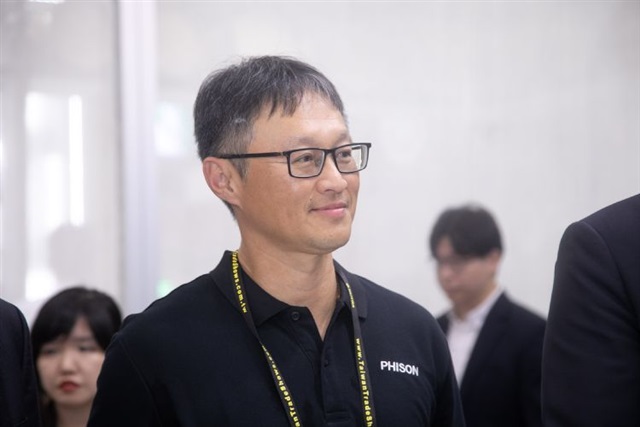
When a company like Phison, specialized in designing flash memory controllers, talks about the market, those managing hardware infrastructure listen carefully. The latest statement from the Taiwanese firm goes straight to the heart of one of the industry's most unpredictable dynamics: the NAND boom-and-bust cycle, that pendulum between oversupply and shortage that has conditioned global storage costs for years. Phison believes that artificial intelligence could erase this cyclical pattern, ushering in an era of more stable demand.
NAND memory, the key component in SSDs and memory cards, has always followed an almost seasonal pattern: periods of heavy investment in production capacity lead to an oversupply of chips, causing prices to collapse; then rising demand or production cutbacks result in sudden spikes. For enterprises sizing their datacenters, predicting storage costs over a three-to-five-year horizon has been a complex exercise, if not a frustrating one.
The advent of AI workloads, particularly training and inference with ever-larger models, is changing the game. Training an LLM requires petabytes of data, periodic checkpoints, and intensive I/O. Even during inference, techniques like retrieval-augmented generation (RAG) and vector databases demand high-performance, high-capacity storage, often shared across multiple GPU nodes. Such sustained demand, predictably growing for years, could absorb much of the production capacity, smoothing out price swings.
For teams evaluating on-premise deployment of large models, this prospect has a concrete impact on TCO. More stable storage pricing lets them plan medium-term investments without the risk of finding costs doubled at the next refresh. One must not forget, however, that NAND memory is just one piece: the overall cost of an AI cluster is dominated by GPUs, HBM, and networking. A stabilization of NAND prices doesn't eliminate volatility in other critical components.
It remains to be seen whether Phison's forecast will come true. Historically, every time a technology promised to "change the rules" of chip manufacturing, reality proved more complex. But the signal is important and fits into a context where AI demand is reshaping the entire hardware supply chain, from foundries to memory makers.







💬 Comments (0)
🔒 Log in or register to comment on articles.
No comments yet. Be the first to comment!