
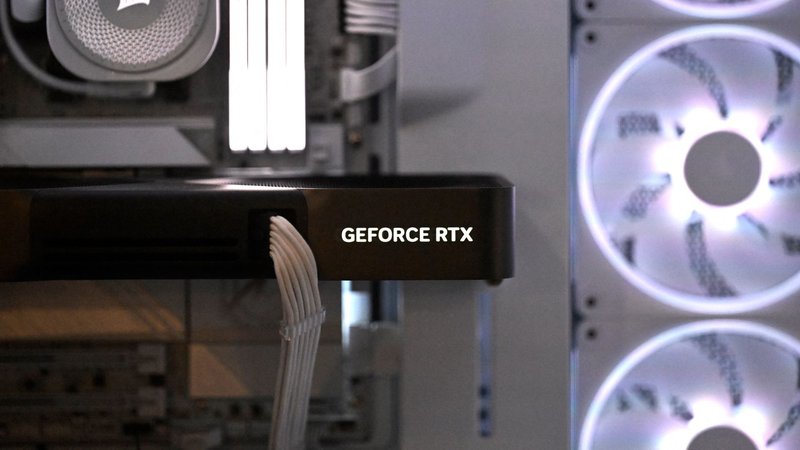
Hundreds of posts ask Opus 5.5 to generate motion graphics videos. The author of the Reddit thread took a different route: they showed those examples to Qwen 27B and asked the model to produce its own version. The rendering ran on a single RTX 4090, a detail that matters for anyone watching the perimeter of local models.
The clip posted on the forum looks choppy because of Reddit's gif limit. The full high-resolution version with sound is on X; the project relies on Accuretta, a repository available on GitHub. That detail shifts the center of the story: it is not just a demonstration of generative capability, but the assembly of a flow that goes from multimodal input to a finished video on consumer hardware.
For those evaluating self-hosted deployment, the signal is twofold. On one side, a 27-billion-parameter model running on a consumer GPU opens the way to creative iterations without a per-call variable cost. In a production context, this changes the TCO calculation: the initial hardware investment remains, but the marginal cost of trial runs and discarded outputs approaches zero. On the other side, the framework makes the difference. Without an orchestrator that handles prompts, outputs and pipeline management, the model alone is not enough to produce a shareable video. Accuretta is the glue here: it makes repeatable a process that would otherwise remain a one-shot experiment.
The source publishes no benchmarks, no latency, throughput or perceived quality data. The comparison with Opus 5.5 should therefore be read as a positioning signal, not as a competitive test. We do not know how long the generation took, how much VRAM was occupied during inference, or whether the flow holds up on longer batches. What is visible is a proof of existence: a multimodal creative task, previously considered territory for frontier cloud models, has been replicated in a local context with a medium-sized model.
There is a structural effect here. When open medium-sized models become sufficient for a visible use case, competition shifts from the checkpoint to the ecosystem: providers of tooling, deployment guidance and resource optimization become more relevant than those offering only proprietary APIs. For creative teams, this reduces dependence on a single vendor and brings control over prompts, weights and content back inside the organizational perimeter. For cloud vendors, it erodes the advantage of being the only place where certain tasks are possible.
The choice between cloud and on-premise is not just a per-token cost issue: it involves reproducibility, version control and operational constraints. AI-RADAR publishes analytical frameworks in the /llm-onpremise section to evaluate these trade-offs, without turning a case like this into a single recommendation.
The video in its full version is online, the repository is public. The rest — durability under continuous workloads, reproducibility on different hardware, the real energy cost — is not yet documented. And that is the most interesting observation point for those who are not satisfied with demos.








💬 Comments (0)
🔒 Log in or register to comment on articles.
No comments yet. Be the first to comment!