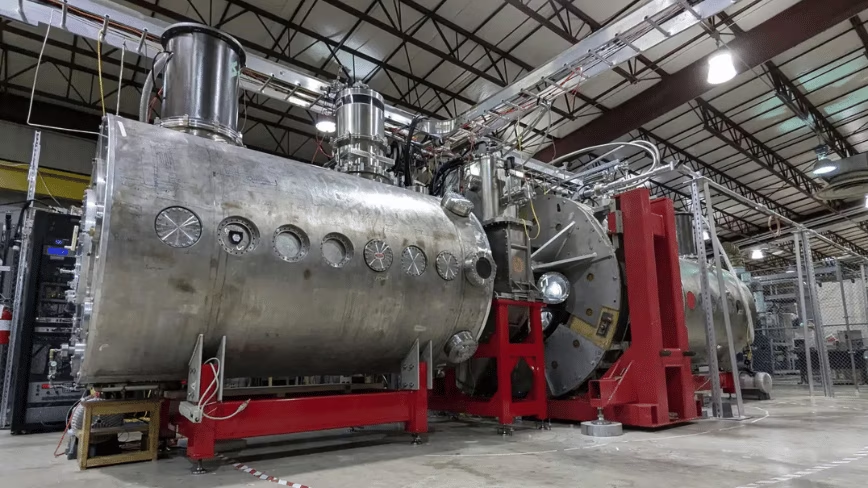
The news comes from Wisconsin, where startup Realta Fusion has lit up a few bulbs using energy produced directly from its experimental reactor. It’s the first demonstration of this kind with commercial goals and marks a different kind of milestone: not just beating the record for energy output versus input, but transforming that same energy into something immediately useful.
Direct conversion: why skip the turbine
In conventional fusion reactors, the process unleashes high-energy neutrons that heat a fluid; that heat is then converted into electricity through turbines and generators, with inevitable thermodynamic losses. With a direct conversion system, like the one demonstrated by Realta, part of the energy from charged particles is captured and turned into current without intermediate steps. The company hasn’t disclosed technical details, but the visible result – the lit bulbs – suggests promising efficiency for small-scale applications.
Beyond the record: the path to profitability
For years, the fusion race was dominated by the goal of achieving net energy gain (Q>1). Now that several projects, including the National Ignition Facility in the US, have broken that barrier, the priority has shifted to economic engineering. Producing more energy than you put in isn’t enough if the resulting electricity remains prohibitively expensive. Realta’s demonstration points to an alternative: more compact devices with direct conversion could reduce complexity and plant costs, bringing the day when fusion becomes competitive on the market closer.
What does AI have to do with it? Impact on on-premise infrastructure
For those managing on-premise computing infrastructure – think GPU clusters for LLM inference – energy is an increasingly critical line item. Training and running Large Language Models require massive amounts of power, and electricity price fluctuations directly affect TCO. A clean, stable, and potentially decentralized energy source like direct-conversion fusion could change the game: it would enable self-sufficient data centers, even in areas with weak grids, strengthening data sovereignty and reducing dependence on cloud providers. Of course, we’re still far from commercial applications of this scale, but experiments like Realta’s chart a course toward an energy infrastructure better suited to the age of artificial intelligence.
Outlook and skepticism
Many experts remain cautious: lighting a few bulbs is very different from powering an industrial plant. Fusion faces huge challenges in plasma management, materials, and long-term stability. Yet the fact that a startup managed to go from a lab experiment to tangible electrical output adds credibility to the commercial fusion narrative. If the next steps confirm scalability, we could see an acceleration of investments, not just from energy giants but also from Big Tech, always on the hunt for solutions to their soaring electricity needs.
The circle closes with a bulb. A small gesture that, if replicated on a larger scale, could truly light the way to a zero-emission, cost-controlled future.








💬 Comments (0)
🔒 Log in or register to comment on articles.
No comments yet. Be the first to comment!