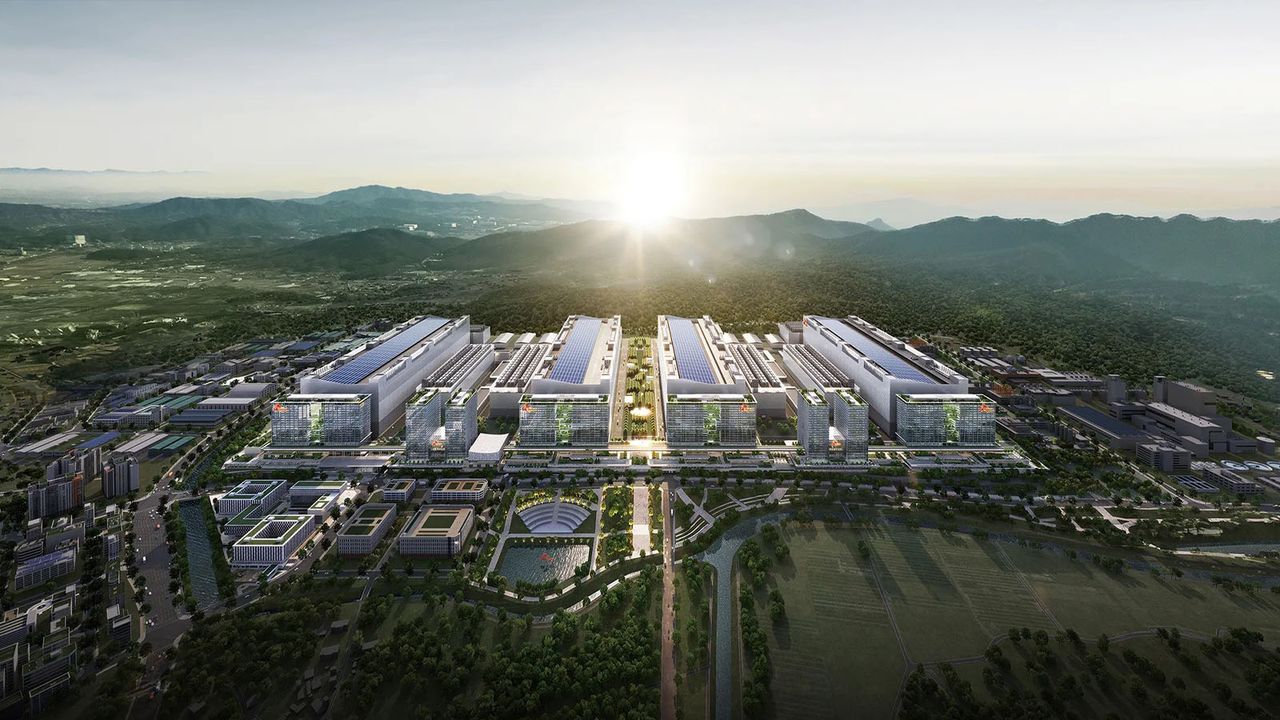
The number is dizzying: $712.5 billion. Not the annual budget of a cloud provider, but the new investment plan SK hynix has just detailed for its South Korean operations. Two manufacturing poles will absorb the push: the expansion of NAND facilities in Cheongju and the emerging Yongin Semiconductor Cluster, dedicated to DRAM memory. The announcement carries enormous weight for anyone working with artificial intelligence workloads, because without memory, no LLM can function.
Why memory has become the real AI bottleneck
Ever since Large Language Models began devouring terabytes of VRAM for inference and fine-tuning, the availability of high-speed memory chips has become a critical variable. It is not just about having GPUs with enough onboard VRAM: bandwidth, latency, and DRAM module density determine how many tokens per second an on-premise node can actually process. For the most demanding workloads – think of a 70-billion-parameter model served on self-hosted hardware – the difference between a well-balanced infrastructure and an underpowered one often comes down to memory.
SK hynix plays a leading role in this chessboard: it is one of only two global suppliers of HBM (High Bandwidth Memory), the stacked memory found in the most powerful accelerators, including NVIDIA H100 chips and their successors. The new Yongin cluster, designed to scale advanced DRAM production, arrives at a time when the HBM demand pipeline is under pressure and lead times are stretching. For an organization evaluating local deployment of an AI cluster, certainty about the memory supply chain means being able to plan CapEx and rollout schedules without nasty surprises.
Impact on the Total Cost of Ownership of an on-premise cluster
In an on-premise TCO analysis, memory’s impact is less visible than GPUs’ but equally profound. It is not enough to buy top-tier cards: the entire stack – from the memory controller to the interconnect buses – must be balanced to sustain the required throughput. If the DRAM market tightens, prices rise and those running a self-hosted fleet find themselves renegotiating budgets or, worse, postponing expansion. SK hynix’s investment, with its decade-spanning magnitude, signals the opposite direction: it bets on future supply abundance, which for enterprise buyers could mean wider margins and more predictable lead times.
There is also a less obvious but crucial aspect: the expansion of NAND fabs in Cheongju. While NAND flash lacks DRAM’s media visibility, it is essential for the high-performance storage that feeds data pipelines and caching in AI nodes. A plentiful flow of enterprise-grade NAND can reduce the per-terabyte cost of storage servers, a non-trivial factor when managing datasets of hundreds of gigabytes that must be pre-processed before every training session.
What to watch in the coming months
The sheer size of the investment – $712.5 billion spread over multiple years – suggests SK hynix is reading market signals indicating mass AI adoption well beyond current estimates. For those responsible for deciding whether to bring inference in-house or remain in the cloud, news like this acts as an early indicator of hardware costs and availability. The Yongin Cluster will not produce significant volumes for several quarters, yet today it already reveals that the game for data sovereignty and infrastructure control is played upstream, in the manufacturing capacity of memory semiconductors.





💬 Comments (0)
🔒 Log in or register to comment on articles.
No comments yet. Be the first to comment!