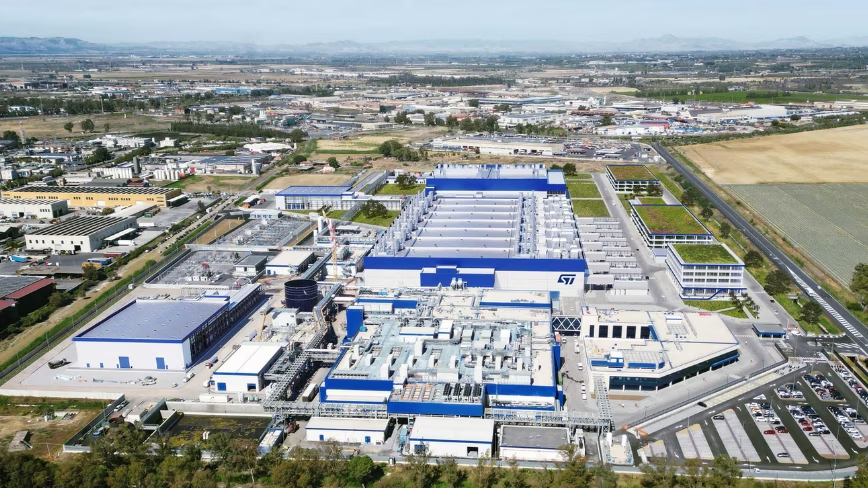
STMicroelectronics Doubles Data Center Revenue Forecast to $1 Billion
STMicroelectronics, the Franco-Italian semiconductor giant, has announced a significant increase in its data center revenue expectations. The company now anticipates reaching approximately $1 billion in revenue from this segment by 2026, a figure that doubles its previous estimate, which was “nicely above $500 million.” This upward revision reflects a combination of key factors shaping the current technology market.
The primary driver behind this growth is the sustained demand for AI infrastructure, coupled with faster-than-expected progress in ramping up production capacity. This scenario underscores the centrality of advanced silicon in powering the expansion of computing capabilities required for Large Language Models (LLM) workloads and other artificial intelligence applications, both for training and inference phases.
AI's Impact on Infrastructure and the Silicon Market
Demand for AI infrastructure is experiencing unprecedented acceleration, driven by the rapid adoption of LLMs and a wide range of artificial intelligence applications across various sectors. This translates into a growing need for specific hardware components, such as high-performance processors, accelerators, and memory, which are fundamental for building modern and efficient data centers. STMicroelectronics, as a chip manufacturer, is well-positioned to benefit from this trend.
The increase in production capacity, as cited by the company, is a critical factor in this context. The ability to meet market demand is often a bottleneck for the semiconductor industry. An acceleration in this area not only allows STMicroelectronics to capitalize on existing demand but also helps stabilize the supply chain for essential AI components, a crucial aspect for companies planning long-term investments in dedicated infrastructures.
Implications for On-Premise Deployments and Data Sovereignty
For CTOs, DevOps leads, and infrastructure architects evaluating deployment strategies for AI workloads, the trends in the silicon market have direct implications. The increased demand and production capacity for AI chips can influence the availability and Total Cost of Ownership (TCO) of the hardware required for self-hosted and on-premise implementations. The ability to access components more easily and at potentially more stable costs is an advantage for those aiming to maintain full control over their data and operations.
On-premise deployment decisions are often driven by the need to ensure data sovereignty, regulatory compliance (such as GDPR), and security in air-gapped environments. The availability of adequate silicon is a fundamental prerequisite for building robust local AI stacks. A growing chip market with expanding production capacity can facilitate these strategies, offering greater flexibility and reducing reliance on external cloud services, which may not meet all control and privacy requirements. For those evaluating on-premise deployments, AI-RADAR offers analytical frameworks on /llm-onpremise to assess the trade-offs between costs, performance, and control.
Future Outlook and Challenges in the AI Landscape
STMicroelectronics' revised forecast indicates the industry's confidence in the long-term growth and pervasiveness of AI. However, the landscape remains dynamic. The ability to keep pace with technological innovation and efficiently scale production will be crucial for chip manufacturers. Simultaneously, companies adopting AI will need to continue navigating supply chain complexities, technological evolutions, and the specific needs of their workloads.
The trend towards increasingly powerful and distributed AI infrastructure will require careful strategic planning, both for those opting for cloud solutions and for those prioritizing on-premise. The availability of high-performance hardware, the management of energy costs, and the ability to integrate AI solutions into existing stacks will remain absolute priorities for technology decision-makers in the coming years. STMicroelectronics' announcement reinforces the idea that silicon will continue to be the invisible engine of this digital transformation.







💬 Comments (0)
🔒 Log in or register to comment on articles.
No comments yet. Be the first to comment!