
New Restrictions on AI Chip Exports: The Taiwanese Scenario
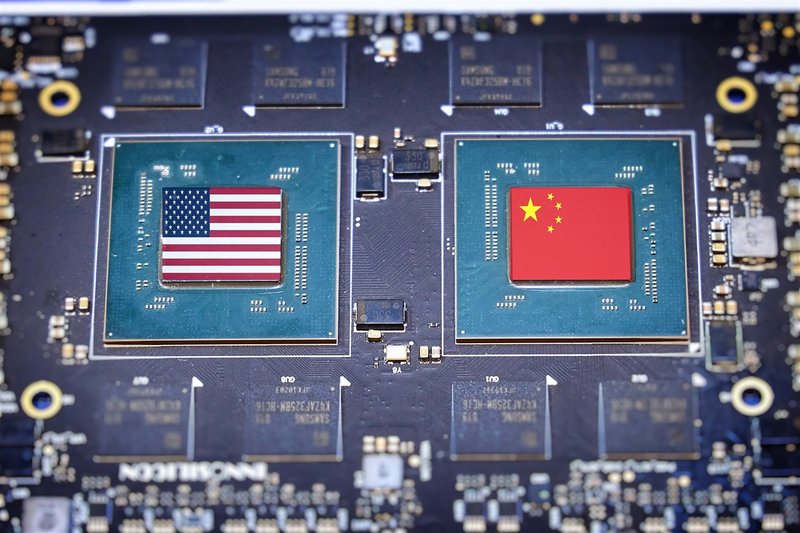
Taiwan is considering a significant escalation in its control policies over advanced technology exports. Authorities on the island are examining the possibility of imposing a criminal ban on the export of artificial intelligence chips to all of China. This move would represent a tightening of current measures, which primarily focus on a specific list of companies and entities subject to restrictions. The goal is to curb the flow of critical hardware that powers the development and deployment of AI systems, particularly Large Language Models (LLMs), in mainland China.
The proposal is far-reaching: it would not only extend bans to all Chinese companies but also make the smuggling of servers containing these chips a criminal offense. Such a measure underscores growing concerns about the strategic use of AI technologies and Taiwan's desire to maintain strict control over its semiconductor production, a sector in which it holds undisputed global leadership. The implications of such a decision would extend far beyond regional borders, affecting the entire global AI hardware supply chain.
The Impact on AI Infrastructure and On-Premise Deployment
For companies evaluating the deployment of LLMs and other AI applications, particularly in on-premise contexts, this potential restriction introduces new complexities. The availability of high-performance GPUs, such as those produced by NVIDIA (e.g., A100, H100) or AMD, is fundamental for large-scale AI model inference and training. A broader export ban could further reduce the global supply of these components, leading to increased costs and longer lead times for all market players, not just those directly involved in trade with China.
This scenario accentuates the importance of strategic planning for AI infrastructure. CTOs, DevOps leads, and infrastructure architects must consider geopolitical risks as critical factors in calculating the Total Cost of Ownership (TCO) for their self-hosted solutions. Hardware scarcity may push organizations to explore alternatives, such as model optimization through Quantization techniques to run them on less powerful hardware, or the adoption of more efficient inference Frameworks, in order to mitigate the impact of supply chain restrictions.
Data Sovereignty and Technological Control: A Broader Picture
Taiwan's move is part of a broader global context of increasing focus on technological sovereignty and national security. Control over AI hardware is not just an economic issue but also a strategic one, as these chips are the foundation for developing advanced capabilities in sectors such as defense, research, and industrial innovation. For companies operating in air-gapped environments or with stringent compliance and data sovereignty requirements, the ability to procure and manage on-premise hardware without interruption is crucial.
Export restrictions on critical components can directly affect a company's ability to build and maintain a robust and independent AI infrastructure, essential for ensuring full control over its data and models. This prompts organizations to more carefully evaluate the trade-offs between cloud and self-hosted solutions, often favoring the latter for security and autonomy reasons. AI-RADAR offers analytical frameworks on /llm-onpremise to support these evaluations, highlighting the constraints and opportunities of each approach.
Future Prospects for the AI Chip Market
The eventual adoption of these measures by Taiwan could redefine the dynamics of the global AI chip market. While some might see an acceleration of efforts to develop AI chip manufacturing capabilities in other regions, the path is long and complex, given the sophistication and capitalization required. In the short to medium term, supply chain tensions are expected to persist, making hardware procurement management a strategic priority for companies investing in AI.
This scenario underscores the importance of a resilience strategy for AI infrastructures. Deployment decisions, whether on-premise, hybrid, or edge, will increasingly need to consider not only performance and TCO but also supply chain stability and geopolitical risks. The ability to adapt to a constantly evolving environment, characterized by restrictions and innovations, will be a key factor for success in the artificial intelligence landscape.








💬 Comments (0)
🔒 Log in or register to comment on articles.
No comments yet. Be the first to comment!