
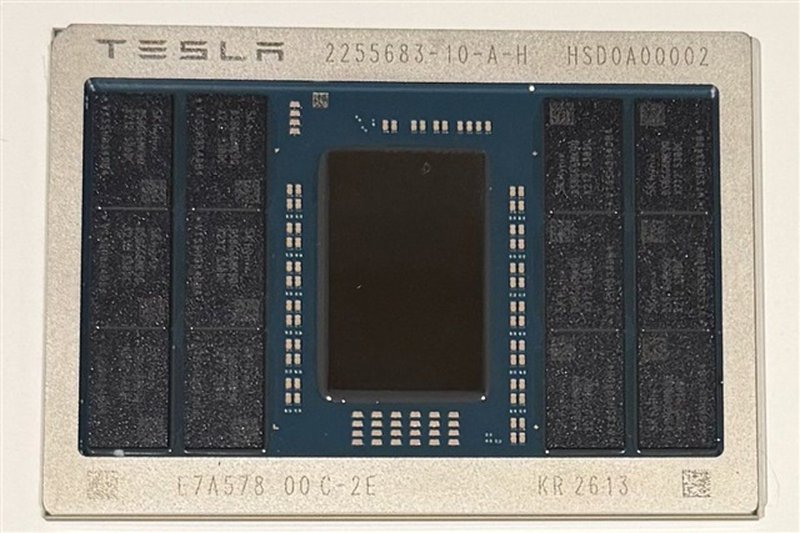
The news broke quietly, almost a rumor: Tesla’s AI5 chip has reportedly completed tape-out at Samsung’s foundry in Austin, Texas. Behind this technical milestone lies a larger puzzle of industrial ambition, geopolitical calculation, and a question nagging every CTO evaluating in-house AI deployment: how much should you rely on external suppliers when AI becomes a strategic asset?
Tape-out is the stage where a silicon design moves from simulation to physical prototype production. For Tesla, it marks yet another declaration of independence. Elon Musk’s company is no longer content buying GPUs from NVIDIA or AMD to power the Dojo supercomputer dedicated to training self-driving models. It has been developing custom architectures for years — the D1 chip was the first glimpse — and now AI5 appears ready for real-world testing. This isn’t just an edge inference accelerator for vehicles; the choice of an external foundry of this caliber suggests volumes and ambitions targeting large-scale training.
The real story, though, is the location. Samsung operates a cutting-edge fab in Taylor, Texas, near Austin. Choosing Texas over an Asian partner is not a logistical detail — it’s a message to the market and policymakers. Manufacturing stays on U.S. soil, indirectly benefiting from CHIPS Act incentives and reducing exposure to geopolitical tensions in the Taiwan Strait. For a company that treats its training data and models as an inalienable competitive edge, silicon sovereignty becomes as vital as software sovereignty.
Those involved in on-premise Large Language Model deployment know the chip supply chain is a weak link. The most powerful GPUs come almost exclusively from TSMC, and any shock in the Asian region instantly transmits to pricing and availability. By internalizing part of the design and engaging multiple foundries, Tesla is building an alternative supply chain that could become a benchmark for other firms with massive compute needs and sensitive data. It’s not far-fetched to imagine that, if AI5 achieves the expected performance, Tesla might one day offer its compute capacity or even license the architecture, following the path already trodden by Amazon with Trainium or Google with TPUs. In that scenario, Texas would become a hub for US-made AI silicon.
Technical unknowns remain. Without official numbers on VRAM, bandwidth, or 8-bit floating-point support, it’s premature to compare AI5 to an H100 or an MI300. But the direction is clear: the market is splintering into specialized silicon, and Tesla’s move strengthens the thesis that AI’s future is hybrid — cloud for elasticity, on-prem and bare metal for control, with chips tailored to specific workloads. For AI-RADAR readers who daily analyze TCO, latency, and data residency trade-offs, stories like this confirm that proprietary hardware is no longer a niche; it’s a central pillar of long-term strategies.



💬 Comments (0)
🔒 Log in or register to comment on articles.
No comments yet. Be the first to comment!