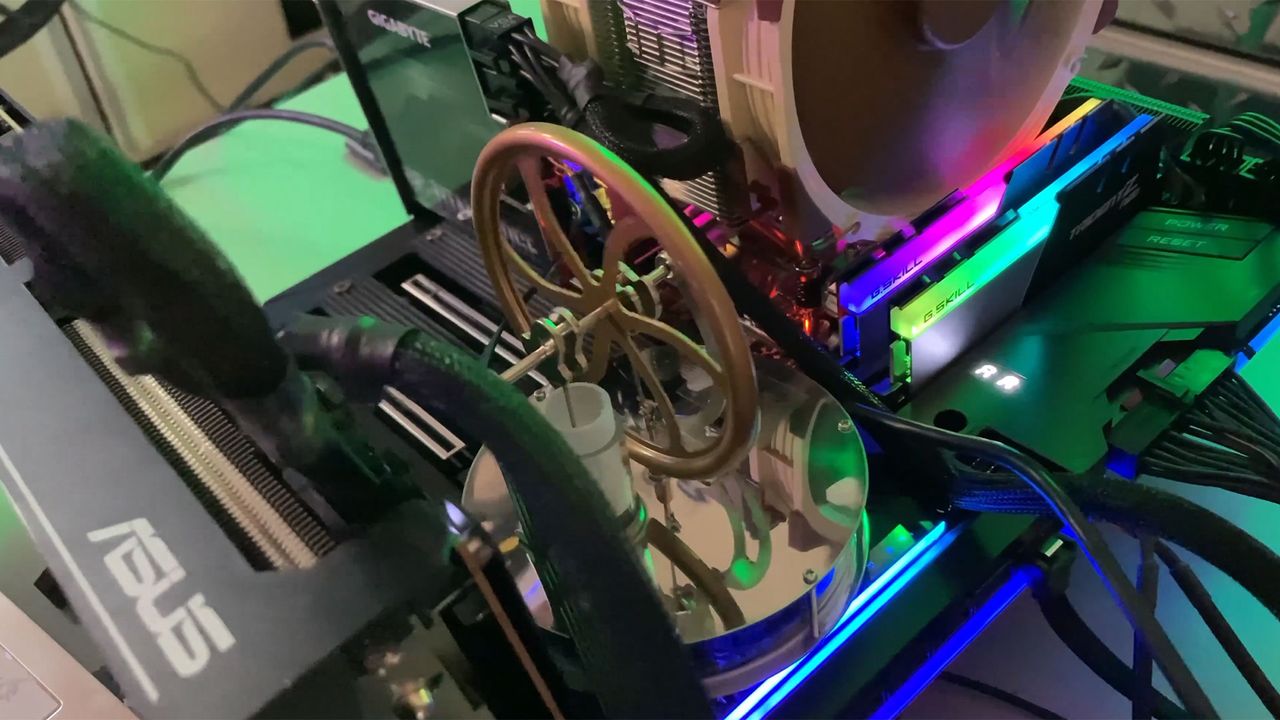
The idea of fighting processor heat with a combustion-free engine invented in 1816 sounds like a steampunk tale. Yet a well-known Windows community modder has done exactly that: he installed a small Stirling engine on the heatsink of an AMD Ryzen Threadripper 3970X, using waste heat to spin the flywheel and generate extra airflow.
The Stirling engine, conceived by Reverend Robert Stirling two centuries ago, converts a temperature difference into mechanical work. In this case, heat dissipated by the CPU (with a 280-watt TDP) warms the engine’s lower end, while ambient air cools the upper part: the thermal gradient moves the piston and spins the flywheel, which is connected to a fan that helps remove heat without drawing any power from the PSU.
It is hardly a thermal revolution, but the principle is what matters. The Stirling engine costs about $40, runs silently, has no electric circuits, and operates as long as a thermal gradient exists. In an age where local inference and LLM fine-tuning systems demand ever more power-hungry CPUs, every watt of heat to be removed affects acoustic comfort and energy bills. Reusing part of that heat to self-power a passive cooling mechanism goes beyond the hacker gesture: it hints at a direction where high‑performance PCs could become partially self‑sufficient in thermal management.
Anyone assembling on-premise workstations for AI workloads knows the problem well. Threadripper and Intel Xeon W counterparts consume hundreds of watts and require bulky, often noisy cooling solutions. Adopting a Stirling engine is not practical at scale – cooling capacity is modest and critically dependent on temperature difference – but it demonstrates how the loop can be closed: heat, rather than being merely an enemy, becomes a resource.
The mod is not only about the technical feat. It is also a reminder that innovation in thermal management does not necessarily have to go through expensive liquid cooling or increasingly sophisticated PWM fans. Sometimes the solution can be simpler and quieter, drawing from a technological heritage we thought was obsolete. For those working in noise-sensitive environments such as recording studios or development labs, a system that cools itself without any electrical moving parts could represent a concrete advantage – albeit with the scalability limits of a handcrafted prototype.
The Threadripper 3970X with its 32 Zen 2 cores remains a reference platform for parallel computing and virtualization. Seeing it paired with an object that looks like it came from a science museum prompts reflection on how maker culture is exploring side paths, far from official datasheets. The negligible cost of the experiment – $40 – and its implicit open-source nature make it an example of engineering frugality applied to hardware worth thousands of euros.







💬 Comments (0)
🔒 Log in or register to comment on articles.
No comments yet. Be the first to comment!