The signal: the NPU enters the local pipeline without asking permission
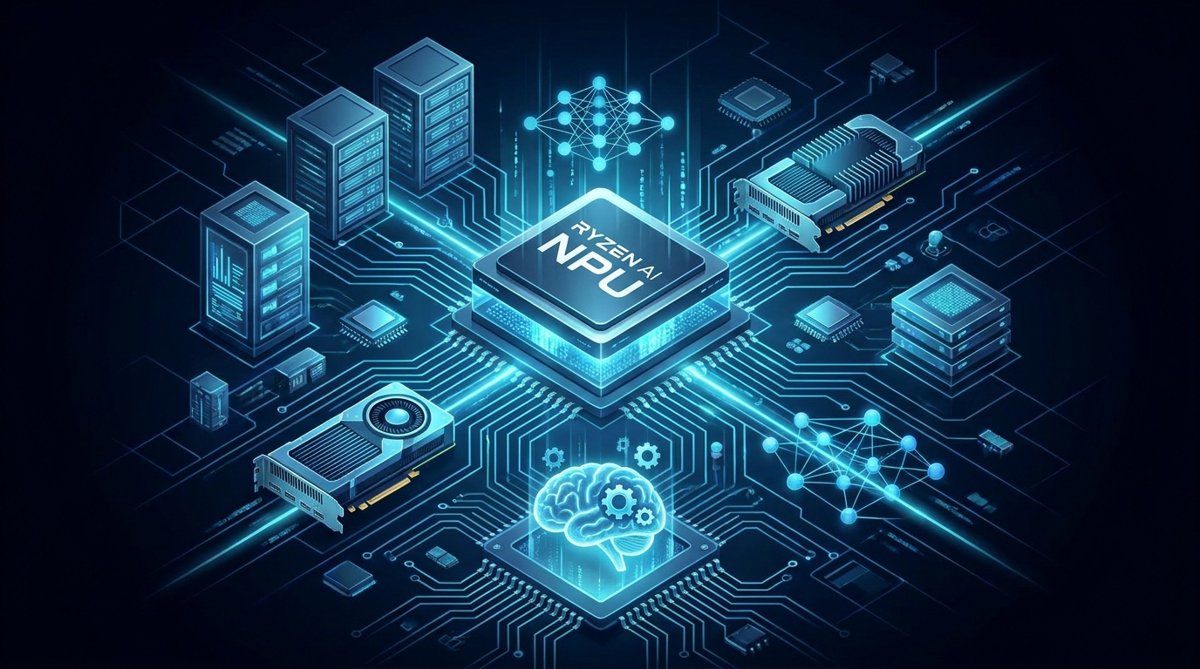
The joint announcement from AMD and Unsloth does not simply add a newly supported device. It shifts the center of gravity of local Inference. Unsloth is known mainly for techniques that reduce VRAM consumption during LLM fine-tuning. Now those optimizations leave the model preparation phase and land on an integrated accelerator, the Ryzen AI NPU, starting with XDNA 2 architecture units. For developers used to treating the NPU as marginal or experimental, the signal is clear: heterogeneous hardware is starting to enter operational pipelines.
The difference from the past is cultural before technical. Integrated NPUs have long been relegated to Windows demos or system functions, with little access for those working with LLMs. Unsloth brings its optimization approach, historically oriented to squeezing limited resources, into this space. This is not a promise of discrete GPU performance, but a change of perspective: some light Inference workloads can be absorbed by components already present in the processor, without additional hardware.
The point is not to declare winners. But the presence of an NPU in many Ryzen AI processors becomes more relevant when a project like Unsloth treats it as a credible platform. For those building local applications, this reduces the friction of designing only around a discrete GPU. The road to a distributed architecture, where CPU, GPU, and NPU share workloads, is still long, but the announcement signals that this is no longer just experimentation.
Why Linux support is the real operational watershed
Many edge and on-premise scenarios – kiosks, industrial workstations, appliances, compact servers – run on Linux. Without reliable drivers and runtimes, an NPU remains an unused component, regardless of its on-paper specifications. Unsloth's entry into this space does not guarantee high performance, but it attacks one of the main points of friction: the need to build a local Inference stack from scratch on heterogeneous hardware. Historically, software support has slowed NPU adoption outside Windows environments and demos.
Linux support also changes the nature of deployment. When the runtime is available on the most common operating system for embedded and server contexts, the integrated accelerator can be evaluated with the same criteria as other components. Teams building an appliance or on-premise service no longer have to assume the NPU is inaccessible. This simplifies the design of pipelines that alternate CPU, GPU, and NPU depending on the workload, without being locked into a proprietary operating system.
There is a subtler point, however. Linux availability does not automatically mean portability. Each NPU has different specifications, and runtimes can vary. The real value of support depends on how much APIs and model formats remain consistent across distributions and hardware. For now, Unsloth's entry is a sign of maturity, not a definitive solution to fragmentation. But for those managing compact Linux servers or edge stations, it reduces the distance between experimentation and production.
TCO, sovereignty, and the question teams should ask themselves
The immediate stated benefit is reduced dependence on discrete GPUs for lighter Inference workloads. For teams developing local applications, this can mean lower TCO and a simpler pipeline, especially when data must not leave the machine. The NPU is already included in the processor: it requires no separate purchase, does not add power consumption comparable to a dedicated card, and can handle small models with a reduced thermal profile.
Data sovereignty is the other side of the coin. Many light workloads currently go to the cloud for lack of practical local alternatives. An integrated NPU accessible on Linux allows on-site processing of text, classification, extraction, or small assistants, avoiding the transfer of sensitive information. There is no need to imagine models with hundreds of billions of parameters: even compact LLMs, with moderate quantization, can cover real use cases in regulated contexts.
However, TCO is not limited to hardware cost. Integration complexity, runtime maintenance, maturity of development tools, and the risk of adapting models to a specific accelerator must be considered. The NPU can reduce operating costs, but it can introduce management costs if the software ecosystem is not stable. For a serious on-premise analysis, the comparison between NPU, GPU, and cloud APIs does not reduce to cost per token: AI-RADAR collects analytical frameworks on /llm-onpremise to compare these scenarios.
Structural limits: bandwidth, memory, and the risk of fragmentation
Integrated NPUs do not have the memory bandwidth or compute capacity of a discrete GPU. Teams working with large LLMs or less aggressive quantization will continue to prefer dedicated hardware. This is a structural constraint, not a temporary gap. Unified memory helps avoid explicit transfers, but it does not replace dedicated VRAM when model and context grow. The NPU can be efficient, but only within a defined perimeter.
For smaller models and edge use cases, the trade-off between latency, consumption, and privacy can become attractive. A local assistant that responds without calling the cloud, a classification system running next to a production line, an extraction module that does not export data: these are scenarios where the NPU can absorb workloads currently delegated to external services. The point is not to replace GPUs, but to absorb a class of work that today lacks practical local alternatives.
Fragmentation remains the biggest risk for developers. Each NPU has its own specifications, and model portability across different accelerators is an open problem. If each vendor imposes proprietary formats and runtimes, migration costs can cancel TCO advantages. This is why Linux availability and the entry of cross-cutting projects like Unsloth matter: they reduce the probability that the NPU remains an island incompatible with the rest of the stack. But vigilance is necessary.
The competitive game: AMD, CUDA, and the role of software
For AMD, the move has a precise competitive value. Software is historically the Achilles heel compared to the CUDA ecosystem. Aligning with a project like Unsloth, already adopted by those seeking efficiency in fine-tuning, can make Ryzen AI NPUs a credible Inference platform, not just a marketing accessory. The goal is not to close the gap with CUDA, but to build an alternative space where the integrated accelerator has a defined role.
Unsloth brings a community of developers attentive to resources. Those who use it to reduce VRAM consumption in fine-tuning are naturally interested in whether the same models can run in Inference on less expensive hardware. This creates a field-test effect that hardware announcements alone do not produce. Linux availability expands the user base and makes use possible in contexts that Windows does not cover.
Vendor neutrality requires avoiding exaggeration. Unsloth's entry does not eliminate CUDA advantages for those training models on NVIDIA GPUs. It does not turn the NPU into a GPU. But it introduces a real competitive element on software, not only silicon. The open question is whether other frameworks will follow the same path and whether runtimes will become mature enough to make the NPU a predictable choice in on-premise deployments.
What to watch: from runtimes to real benchmarks, the path has just begun
The main signal is that local Inference is moving past the experimentation phase. The direction is a more distributed architecture, where CPU, GPU, and NPU share workloads based on context. But for this to become operational, stable runtimes, clear documentation, and support for common model formats are needed. A compatibility announcement alone is not enough: we need to see whether real applications can exploit the NPU without excessive manual intervention.
For those evaluating on-premise or hybrid deployments, the trade-offs between NPU, GPU, and cloud APIs do not reduce to cost per token. One must observe ease of integration, model portability, maturity of development tools, and predictability of maintenance costs. An integrated accelerator can reduce TCO in some scenarios, but it can introduce complexity if the ecosystem is not ready. The advice is not to adopt, but to monitor carefully.
The signals to watch are few and concrete: new Linux runtimes, support for quantization on NPUs, independent benchmarks on real workloads, and especially edge use cases that abandon the cloud. If these elements consolidate, the NPU could become an ordinary component of local pipelines. Until then, it remains a promising option for a class of light workloads, not a substitute for discrete GPUs.




💬 Comments (0)
🔒 Log in or register to comment on articles.
No comments yet. Be the first to comment!