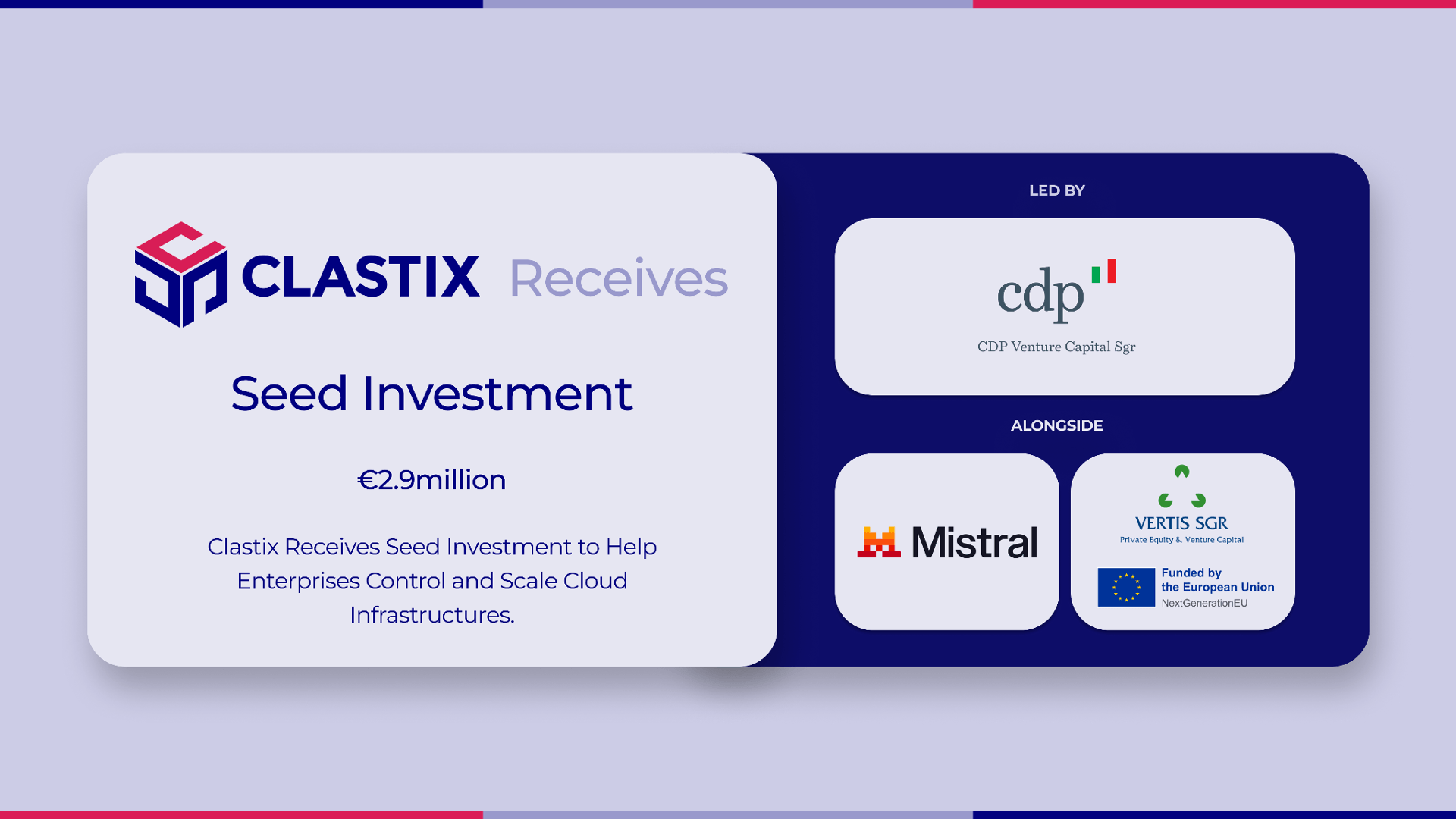
Clastix, an Italian company focused on Kubernetes operations, has raised €2.9 million in a seed round led by CDP Venture Capital Sgr. Mistral and VERTIS SGR, through the Vertis Venture 6 Digital Sud fund partly financed by the European Union's Next-Generation EU programme, also participated. The announcement goes beyond the funding number: Mistral is not only an investor but also a customer using Clastix technology to manage its own Kubernetes infrastructure. That detail turns the news into a signal about how the infrastructure layer for AI workloads is being reshaped.
The problem Clastix addresses is familiar to anyone running Kubernetes at scale. As the number of clusters grows, so does the amount of resources dedicated to control planes, the components that coordinate nodes and maintain cluster state. In a traditional setup each cluster consumes dedicated machines or nodes for control, with costs and operational complexity rising rapidly when teams, environments and workloads multiply.
Clastix takes a different direction: moving control planes onto shared infrastructure. The company develops two complementary products. Kamaji is the open-source engine, available under the Apache 2.0 licence, that implements the Hosted Control Plane concept. kMetal is the commercial platform designed for fleet management, governance and production operations. The combination allows platform teams to reduce infrastructure overhead, simplify operations and manage deployments at a larger scale.
The weight of the control plane in AI
When clusters are numerous, the difference between traditional control management and a consolidated approach can be substantial. It is not just about saving machines. It is about reducing the number of components to operate, update and protect, freeing time for teams working on actual workloads. For AI labs, telecommunications, cloud services and the public sector — sectors Clastix says are already using the technology in production — this kind of consolidation touches a sensitive point: the ability to scale without losing control of the infrastructure.
Mistral's investment adds a concrete element. Timothée Lacroix, co-founder and CTO of Mistral, said Clastix supports the company's Kubernetes infrastructure and that its work on multi-tenancy and managed control planes helps operate training and inference clusters at scale. His comment is explicit: backing Clastix means investing in Europe's AI stack. A sovereign AI ecosystem, he added, is not just about models but about the infrastructure layer that makes them run.
Beyond models: the infrastructure contest
Mistral's statement shifts attention to a structural point. The next phase of artificial intelligence will not be decided only by model quality, but by who controls the infrastructure that makes models executable and sustainable. Adriano Pezzuto, co-founder and CEO of Clastix, puts it directly: the infrastructure layer supporting AI workloads will become increasingly important. His argument is not just a claim of relevance: if managing dozens of clusters becomes cheaper and less complex, the threshold at which an organisation can afford to experiment with distributed training, large-scale inference and deployments in controlled environments changes.
The second-order effects go beyond direct customers. Platform teams and AI labs gain operational room, but horizontal automation vendors can also strengthen their position. Those building offers that monetise per-cluster complexity or require dedicated control nodes may see less room to justify certain costs. In Europe, where data sovereignty and technological independence are part of the public debate, a leaner Kubernetes infrastructure has value beyond immediate savings.
The round is not just venture capital. The presence of CDP Venture Capital Sgr and a fund partly financed by Next-Generation EU signals an industrial policy direction: infrastructure is considered a building block for a European AI supply chain less dependent on managed services from large providers. For those evaluating on-premise deployments, the trade-offs between consolidation and isolation, between resource savings and security requirements, remain central; AI-RADAR offers frameworks on /llm-onpremise to analyse them without shortcuts.
Clastix will use the funding to support product development, customer success, solutions engineering and go-to-market expansion, while continuing to invest in Kamaji and strengthening R&D capabilities for AI workloads. Over the next three years the company expects to grow its headcount. The bet is that consolidating control planes does not add a new layer of complexity, but removes friction for those who must choose between control and scale.








💬 Comments (0)
🔒 Log in or register to comment on articles.
No comments yet. Be the first to comment!