
CoWoS Capacity: TSMC's Advanced Packaging Limits AI Expansion
TSMC's Chip-on-Wafer-on-Substrate (CoWoS) advanced packaging technology is emerging as a critical factor for the expansion of artificial intelligence. Despite an impressive 80% Compound Annual Growth Rate (CAGR) for advanced packaging, CoWoS production capacity struggles to keep pace with the explosive demand for AI chips, creating a potential bottleneck for the industry.
This scenario highlights the AI sector's reliance on highly specialized manufacturing processes and the challenge of rapidly scaling complex infrastructures. The availability of packaging solutions like CoWoS is fundamental for the realization of next-generation AI accelerators, which require increasingly tight integration between components to maximize performance.
The Strategic Role of CoWoS in AI Hardware
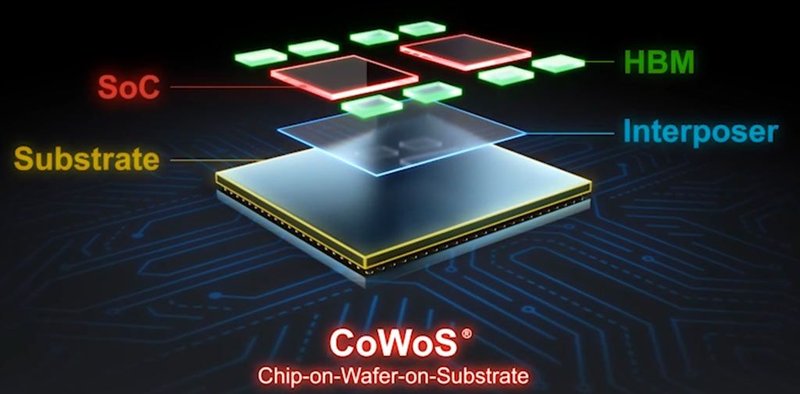
CoWoS is a 3D packaging technology that allows multiple dies (chips) to be integrated onto a single interposer substrate, connecting them with high-density interconnects. This approach is crucial for creating GPUs and other AI accelerators that require enormous memory bandwidth and low latency. Typically, CoWoS is used to stack HBM (High Bandwidth Memory) directly next to the logic die (such as a GPU), drastically reducing communication distances and increasing data throughput.
For Large Language Models (LLM) workloads, the availability of high-speed and high-capacity VRAM is a non-negotiable requirement. CoWoS facilitates this integration, enabling the memory configurations necessary for the Inference and training of increasingly larger and more complex models. Without sufficient CoWoS capacity, the production of these essential chips slows down, impacting the entire AI development and deployment pipeline.
Implications for On-Premise Deployment
The limited CoWoS capacity has direct repercussions for organizations evaluating the deployment of self-hosted AI infrastructures. The scarcity of high-end AI chips, which heavily rely on this packaging technology, can translate into longer lead times and higher acquisition costs (CapEx). This makes planning and implementing on-premise data centers for AI workloads an even greater challenge.
Companies prioritizing data sovereignty, regulatory compliance, or the need for air-gapped environments find themselves balancing the urgency of AI adoption with the reality of a constrained supply chain. The evaluation of the Total Cost of Ownership (TCO) for on-premise solutions must consider not only initial hardware costs but also availability and procurement times. For those evaluating on-premise deployments, AI-RADAR offers analytical frameworks on /llm-onpremise to understand and navigate these complex trade-offs.
Future Outlook and Challenges
Despite the 80% CAGR growth in TSMC's advanced packaging, the demand for AI chips continues to outstrip supply, indicating that the CoWoS bottleneck will persist in the short to medium term. TSMC and other industry players are investing heavily to expand production capacities, but building new fabs and implementing advanced packaging processes require years and significant capital.
This situation drives innovation not only in manufacturing but also in software optimization and the efficiency of existing hardware. Techniques such as Quantization and optimizing LLMs for lower VRAM requirements become even more critical. The future of AI will largely depend on the semiconductor industry's ability to overcome these production challenges, ensuring a steady flow of high-performance hardware to power the next generation of intelligent applications.




💬 Comments (0)
🔒 Log in or register to comment on articles.
No comments yet. Be the first to comment!