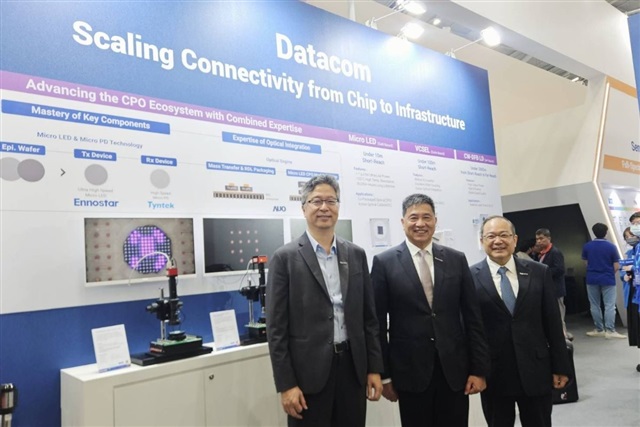
Ennostar Redefines Strategy: Focus on Profit and Innovation
Ennostar, a prominent company in the technology landscape, has announced a significant reorientation of its corporate strategy. Under the leadership of chairman Paul Peng, the focus is now more distinctly on profitability, alongside an acceleration in the development and production of key technologies: Micro LEDs and optical communication solutions. This change of direction reflects market dynamics and emerging opportunities in high-innovation sectors.
Ennostar's decision to bolster these two strategic areas underscores their growing relevance. While Micro LEDs promise advancements in display and lighting, optical communications represent a fundamental pillar for the future digital infrastructure, with direct implications for data centers and data-intensive workloads, such as those related to Large Language Models (LLMs).
The Role of Optical Communications in AI Infrastructure
For IT professionals managing on-premise LLM deployments, the efficiency of optical communications is a critical factor. The ability to transfer enormous volumes of data at high speeds and with low latency is essential for interconnecting GPU clusters, servers, and storage systems. Infrastructures supporting LLM training and inference require massive bandwidth to ensure adequate throughput and optimal response times.
Advanced optical communication solutions, such as fiber optic transceivers and high-speed interconnects, are indispensable for overcoming bottlenecks that can arise in environments with dozens or hundreds of AI accelerators. A robust and high-performing network infrastructure directly impacts the Total Cost of Ownership (TCO) of an on-premise deployment, influencing energy efficiency and future scalability. The selection of appropriate network components is therefore a strategic decision that affects the entire LLM development and deployment pipeline.
Micro LED: Beyond Traditional Display
In parallel with optical communications, Ennostar is investing in Micro LEDs. This technology, while less directly connected to AI infrastructure than connectivity, represents a significant area of innovation. Micro LEDs offer advantages in terms of brightness, energy efficiency, and lifespan compared to traditional display technologies, paving the way for new applications in high-resolution displays, augmented reality, and advanced sensors.
Although their primary impact is not on LLM processing, the evolution of Micro LEDs could find indirect applications in the data center context, for example, for high-fidelity monitoring systems or advanced user interfaces for infrastructure management. Diversification into these technologies demonstrates Ennostar's willingness to preside over sectors with high growth and innovation potential.
Implications for On-Premise Deployments and Data Sovereignty
Ennostar's push towards optical communications reinforces the idea that physical infrastructure remains a crucial element for companies choosing on-premise deployments for their AI workloads. The ability to control every aspect of one's network, from fiber optics to transceivers, is fundamental to ensuring data sovereignty, regulatory compliance, and security in air-gapped or hybrid environments. This approach contrasts with reliance on external cloud infrastructures, where direct control is often limited.
For those evaluating on-premise deployments, AI-RADAR offers analytical frameworks on /llm-onpremise to assess the trade-offs between initial (CapEx) and operational (OpEx) costs, performance, and security requirements. Innovations in sectors like optical communications are directly relevant to these decisions, as they can improve efficiency and reduce long-term TCO, while providing the flexibility and control necessary for the most demanding enterprise strategies.







💬 Comments (0)
🔒 Log in or register to comment on articles.
No comments yet. Be the first to comment!