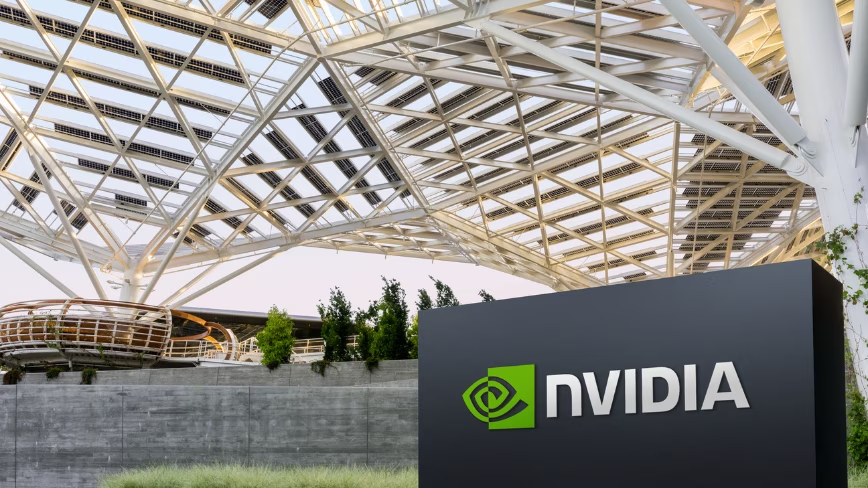
A single circuit board was enough to delay one of the most anticipated launches in artificial intelligence by a year. Nvidia’s Kyber rack – the cabinet designed to house future Rubin Ultra chips – will not arrive in 2027 as planned, but in 2028. The slip was flagged by research firm SemiAnalysis and later reported by CNBC.
Kyber is not a chip: it is an ultra-high-density server cabinet, built to pack dozens of Rubin Ultra accelerators and handle training and inference workloads at unimaginable scale. The culprit is a single printed circuit board, whose malfunction during testing triggered a cascade of reviews and fixes, forcing Nvidia to adjust the timeline. The hiccup says a lot about the complexity of these systems, where every component – from power delivery to cooling and NVLink interconnects – must perform flawlessly.
For those planning next-generation on-premise deployments, the delay is no small detail. Organizations that expected to refresh clusters with Rubin Ultra hardware will now need to extend the operational life of current systems (such as H100 or H200-based ones) or rework their architecture. It’s not just a calendar issue: energy supply contracts, data center floor space, and commissioning pipelines all need recalculating. In many cases, a one-year delay in critical hardware availability can turn into a competitive advantage for cloud or hybrid setups, where resources scale more flexibly.
The episode also highlights the fragility of AI hardware roadmaps. With computing demand growing at breakneck speed, any postponement gives competitors breathing room and forces the ecosystem to rely longer on previous generations. SemiAnalysis did not provide technical details about the faulty board but stressed that the problem was detected late enough to impact shipments. Nvidia has not officially commented, only indicating that the roadmap remains solid, albeit with this adjustment.
For those focused on data sovereignty and control, the message is clear: the path to self-managed AI still passes through long and delicate supply chains. Kyber was supposed to be the jewel in the Rubin crown, but for now it serves as a reminder of how hard it is to translate silicon breakthroughs into rack-ready machines.






💬 Comments (0)
🔒 Log in or register to comment on articles.
No comments yet. Be the first to comment!