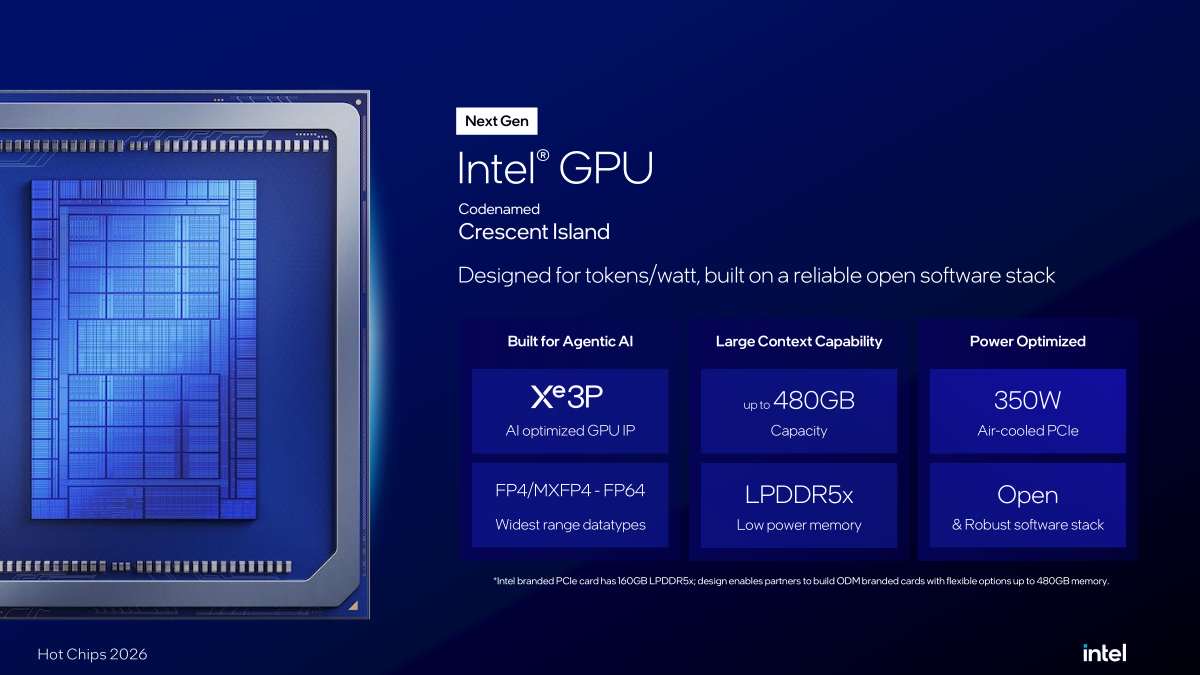
Intel's bet for the next generation of AI accelerators is not only about raw compute. At Hot Chips 2026, Crescent Island surfaced with LPDDR5X memory configurations ranging from 160 to 480 GB: a range that, if confirmed in final products, shifts the competitive battleground from TFLOPS to the memory capacity actually available for models. The report comes from ServeTheHome's coverage and adds a piece to a landscape where high-capacity memory has become a structural bottleneck for Large Language Model inference.
The relevant technical detail is the choice of LPDDR5X, a memory originally designed for mobile and notebooks, instead of the more expensive HBM that dominates data center GPUs. LPDDR5X generally offers lower cost per gigabyte and lower power consumption, but a more limited per-pin bandwidth. In inference workloads on large models, the main constraint is often the number of parameters that must be kept in memory: if an LLM requires hundreds of gigabytes of weights, having 480 GB on a single accelerator reduces or eliminates the need for sharding across multiple GPUs, simplifying architecture and reducing interconnect traffic.
Bandwidth remains the sticking point
Capacity alone doesn't determine performance. LPDDR5X has lower bandwidth than HBM: for distributed training this is a serious limitation, while for many batched or low-concurrency inference workloads the trade-off can be acceptable. The open question is that, without official figures on effective bandwidth and throughput, a possible 480 GB configuration does not yet say how many tokens per second it can generate. But the strategic signal is clear: Intel is trying to shift value from FLOPS to memory capacity, a parameter that is often more critical than peak compute for those evaluating self-hosted deployments.
Who wins and who loses
The second-order implications involve the memory market and the supply chain. If LPDDR5X were to become a credible path for high-capacity AI accelerators, pressure on HBM would ease at least partially, with effects on pricing and availability. HBM suppliers, currently in a strong position, would lose some bargaining power; on the other hand, LPDDR5X memory vendors would see a higher-margin market grow. On the system builder side, configurations with fewer GPUs to host a large LLM could reduce complexity and TCO, especially in on-premise environments where space, cooling and inter-node connectivity carry concrete weight. AI-RADAR dedicates analytical frameworks to these trade-offs at /llm-onpremise, because the choice between capacity and bandwidth is not just a spec-sheet comparison: it touches data sovereignty, operating costs and the freedom to size hardware around the model.
The real test will be whether Intel can turn memory capacity into a sustainable cost-per-gigabyte advantage without paying too high a price in bandwidth. That is what will separate an interesting board from a real alternative for those who currently entrust large LLMs to HBM GPUs.









💬 Comments (0)
🔒 Log in or register to comment on articles.
No comments yet. Be the first to comment!