
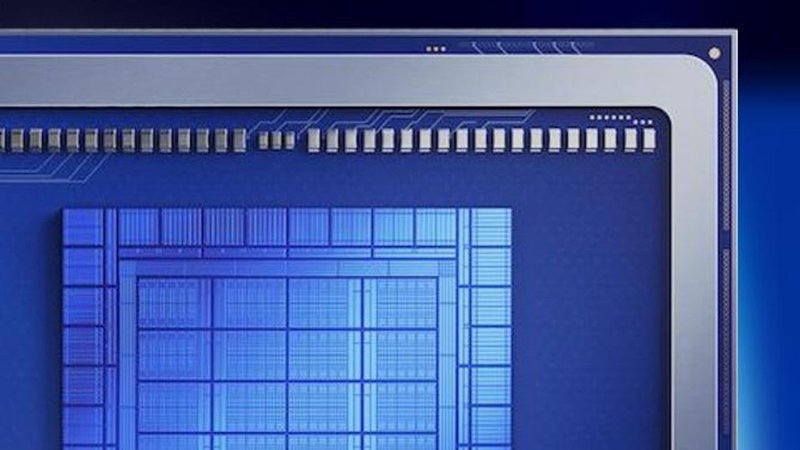
For months Crescent Island was an internal name, almost a hypothesis. Now Intel is turning it into a product line: the D-Series. The published data point to a D270 GPU with 32 Xe3P cores, 256 XMX engines, and up to 480 GB of LPDDR5X when integrated by system makers, while Intel's own variant stops at 160 GB. Memory bandwidth reaches 1.5 TB/s and the rated FP8 peak is 1.3 PetaFLOPS. The form factor is PCIe Gen5 x16, power is 350 W, and cooling is air.
The move carries more weight than a simple name change. Intel is betting on memory capacity as a positioning lever, not on absolute bandwidth. In an AI accelerator market shaped by expensive HBM and hard-to-find boards, offering up to 480 GB of LPDDR5X on a single card shifts attention to a practical problem of local deployments: fitting large models into a standard server without multiplying the number of GPUs. The equally practical trade-off is that 1.5 TB/s of bandwidth must be measured against the throughput required by inference and fine-tuning pipelines. Capacity helps hold the weights, but it says nothing about the tokens per second achievable in production. Teams looking at the TCO of on-premise infrastructure therefore need to separate two variables that are often confused: available memory and useful speed.
The gap between the 480 GB ODM version and Intel's 160 GB version adds a second layer. Server builders will be able to differentiate their machines, but this complicates checks for support, drivers, and thermal compatibility. That is not a cosmetic issue: a 350 W card in an air-cooled CEM form factor can fit into many existing chassis, but thermal behavior depends on airflow and system layout. For a company that wants data sovereignty and hardware control, the promise of a high-capacity GPU is only the starting point. Real integration requires testing drivers, serving frameworks, and quantization strategies. The stated support for FP4 through FP64 suggests flexibility, but efficiency on reduced-precision inference workloads must be proven on real applications, not on datasheet figures. For those evaluating on-premise deployments, AI-RADAR provides analytical frameworks at /llm-onpremise to compare exactly these trade-offs.
There is still no price estimate. That absence matters, because Intel's positioning will be decided on cost per usable gigabyte and cost per served token. A card with a large amount of LPDDR5X can be compelling for inference and fine-tuning of mid-to-large models, but it is not automatically an alternative to HBM platforms for long training runs or highly concurrent workloads. The source also mentions an unofficial hope for a blower-style variant for prosumer workstations: if it arrives, it would open a different channel, but today it is only an aspiration.
In short, the D-Series name turns an experimental GPU into a commercial object. The structural message is that competition is no longer only about peak compute, but about fitting large models within acceptable physical and economic boundaries. For teams choosing self-hosted infrastructure, this changes the terms of comparison: before looking at PetaFLOPS, they need to understand whether the card can hold the model, how fast it can serve it, and at what total cost.








💬 Comments (0)
🔒 Log in or register to comment on articles.
No comments yet. Be the first to comment!