
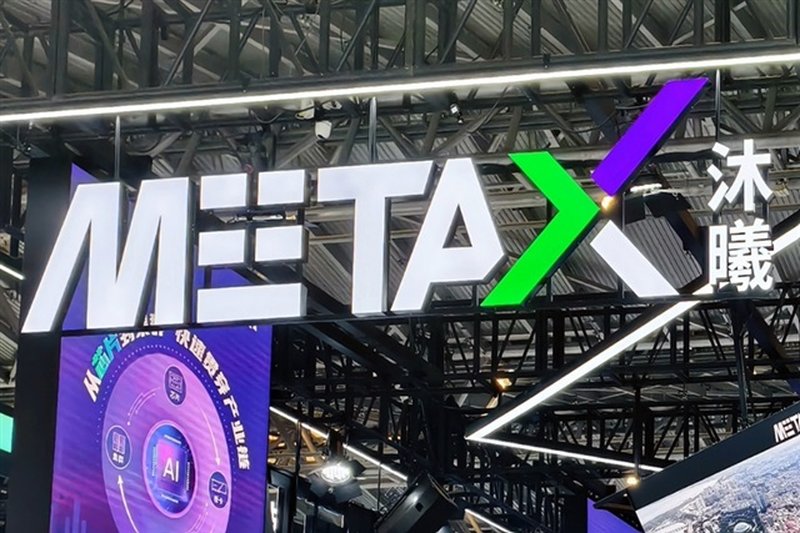
MetaX closed the first half with a profit. In the same period, the picture among Chinese rivals in the AI GPU sector looks divided. The news is more than an accounting note: it shows that the domestic Chinese market, pushed by the need for alternatives to foreign supplies, is starting to separate winners from losers.
MetaX's profitability should not be read as an isolated milestone. For a maker of processors aimed at artificial intelligence workloads, a half-year profit implies that the company has converted at least part of demand into operating margins. In a segment where research, development and production costs are high, closing the first half with a positive result signals that the business model is holding up, at least in this phase.
The divided rivals tell another story. In a young market heavily shaped by trade restrictions, not all vendors have the same ability to absorb costs or to offer a mature enough software ecosystem. The split among competitors may mean that some are still investing at a loss, while others have not yet reached the necessary scale. For anyone watching the sector, the message is not that Chinese AI GPU production has become stable, but that a selection is underway.
The most interesting point for AI-RADAR concerns the indirect consequences for on-premise deployments. GPUs are not isolated components: they must integrate with serving frameworks, manage VRAM efficiently and coexist with inference and fine-tuning pipelines. A vendor that generates profits has more resources to devote to drivers, libraries and long-term support. A vendor that remains in the red may be forced to cut exactly those investments, making its platform riskier to adopt for self-hosted infrastructure.
The divergence between MetaX and its rivals could also change market incentives. If profitability concentrates among a few players, enterprise customers may end up with fewer real alternatives when choosing hardware for local or hybrid environments. This is not a technical detail: for organizations that must keep data on-premise for sovereignty or compliance reasons, the availability of a stable and updated hardware ecosystem is a structural requirement, not an optional extra.
To evaluate these trade-offs, AI-RADAR offers comparison frameworks at /llm-onpremise, where operating costs, software compatibility and confidentiality constraints are analyzed together.
MetaX's profitability does not yet answer the more important question: whether its financial advantage will translate into an ecosystem able to compete with established platforms outside China. But for now it marks a line: in the Chinese race for AI GPUs, someone is starting to make money, while others remain in the trenches.








💬 Comments (0)
🔒 Log in or register to comment on articles.
No comments yet. Be the first to comment!