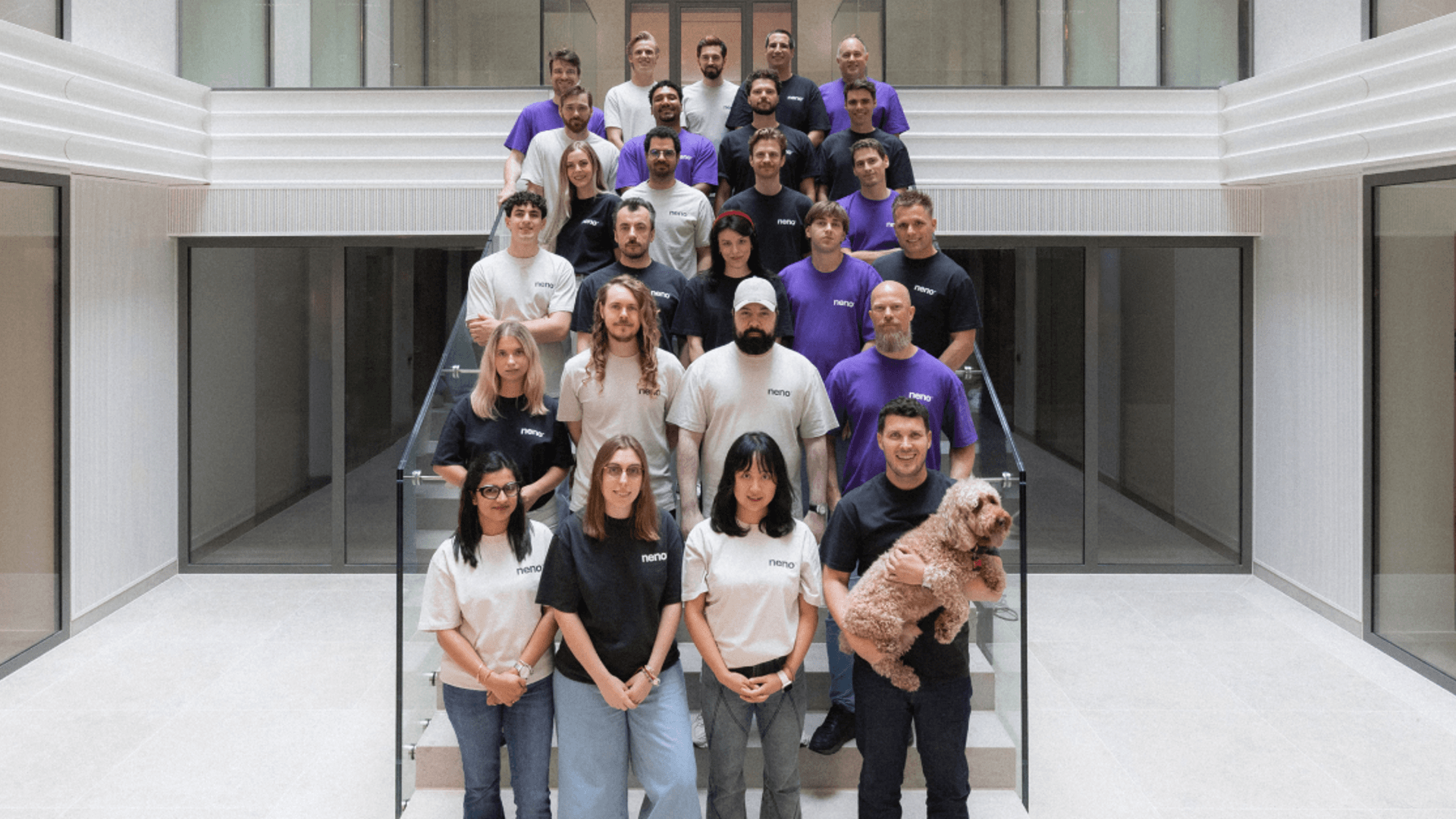
The immediate news is straightforward: Neno, an AI-native financial services company based in Amsterdam, has closed a €6.6 million seed round led by AlleyCorp, with participation from Motive Partners, Firstminute Capital and a group of angel investors that includes executives from Hugging Face, Mollie, Juni, Deel, Miro, Coinbase, PayPal and Navro. Launched in the first quarter of 2026, the company has almost 200 customers and operates in a market where more than half of Europe's 26 million SMEs outsource accounting, payroll and tax obligations, a segment worth around €200 billion per year.
The significant part is not the round size, but the type of infrastructure Neno is building. Its platform is built around a real-time agentic general ledger (AGL), which aggregates data from business bank accounts, corporate cards, bill payments and receivables into a single system of record. From there, the platform automates reconciliation and VAT preparation. The numbers reported by the company point to processes up to five times faster, eight hours of administrative work saved per customer per month and an average reduction of 20 per cent in annual accounting fees.
The critical shift is elsewhere: Neno is not promising to digitise old accounting, but to make it a background activity. CEO Nick Knuppe describes it as a single done-for-you state of work, where reconciliation, compliance and reporting happen automatically and the owner only reviews what has already been handled. That changes the incentives. Small practices that built margins on repetitive collection and reconciliation work lose ground; professionals who move into supervision, review and advisory can support many more clients. Knuppe's thesis is that one Neno accountant can handle hundreds of clients instead of the traditional thirty, without compromising advisory quality.
There is a second, less visible but more structural effect. When an AI-native platform aggregates accounts, cards, payments and receivables into a single system of record, it stops being a simple operational tool and becomes a critical archive. That puts data sovereignty back at the centre. The source does not specify the deployment infrastructure, but an agent that prepares VAT returns and reconciles transactions can only work if it gets access to highly sensitive financial data. In Europe, GDPR and data residency rules impose precise limits on where and how such data can be processed. For companies that cannot move their ledger outside their national or corporate perimeter, self-hosted deployment becomes an option to evaluate, partly because it shifts the audit boundary: you no longer control only the accounting outcome, but also the inference path that produced it.
The new capital will fund Neno Labs, a research and development unit focused on Ambient AI, expand accounting, tax and go-to-market teams, and prepare for entry into additional European markets in 2027. This is where the story connects to deeper industry dynamics: accounting is becoming a continuous processing flow rather than a periodic deadline. Whoever controls the ledger and the agent that governs it can reshape the balance of power among banks, management software vendors, professional firms and end customers. For teams evaluating on-premise deployment of similar agents, AI-RADAR publishes analytical frameworks at /llm-onpremise: not as a preset answer, but to weigh the trade-offs between control, latency and cost.
Knuppe's bet is that the profession will not disappear, but will change function: less data entry, more supervision and advisory. If the model holds, the next fight will not be between software and accountants, but between platforms that own the ledger and professionals who interpret its outputs. The real contest will be over audit, portability and trust.









💬 Comments (0)
🔒 Log in or register to comment on articles.
No comments yet. Be the first to comment!