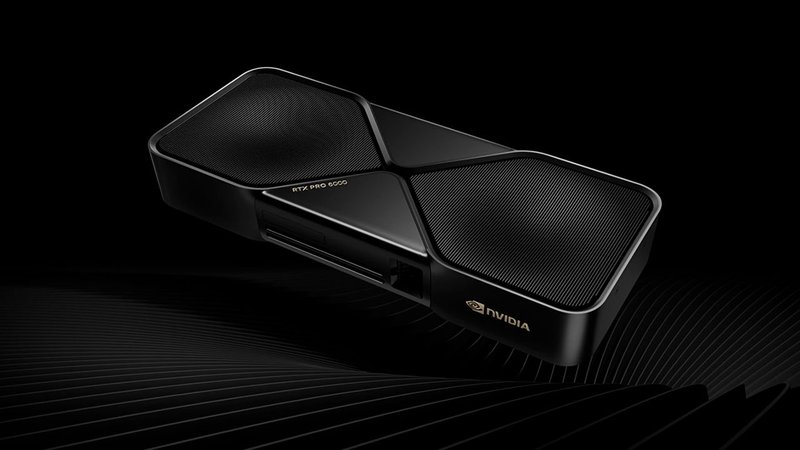
The list price of the RTX PRO 6000 Blackwell has risen to $16,000, double the price at which the 96GB card was available for pre-order last year, when it sat below $8,000. This is not a simple adjustment: it is a signal of the pressure running through AI hardware, especially for teams weighing self-hosted and on-premise deployments.
In a recent interview, investor Gavin Baker noted that several private companies are planning to spend at least twice as much per GPU as existing contracts roll off, and some have said so publicly. The point is not whether this is true, but what it reveals about demand: for part of the enterprise market, the marginal cost of compute is still secondary to the need to avoid falling behind.
The MSRP doubling has concrete implications for anyone building local infrastructure. A card with 96GB of VRAM is not a consumer product: it is designed for workstations and compact servers running LLM inference, light fine-tuning, or model development. At $16,000, the entry cost for a multi-GPU node quickly becomes a TCO problem, not just a CapEx one. If the accelerator price doubles, every budget forecast for self-hosted projects has to be recalculated from scratch.
Baker's comment adds a second layer. If private companies are willing to pay twice as much per GPU, demand is inelastic: teams that have standardized pipelines on CUDA and the Nvidia stack cannot migrate without porting costs, retraining, and compatibility overhead. That gives Nvidia pricing power beyond silicon shortages. The doubling is therefore not an anomaly, but the normalization of a market in which the vendor can raise prices and demand absorbs it.
For organizations evaluating on-premise deployment, the effect is ambivalent. On one side, the increase pushes workloads toward the cloud, where cost shifts from CapEx to OpEx and avoids immobilizing assets. On the other, for teams with data sovereignty requirements or those wanting to avoid cloud provider lock-in, higher hardware prices make access more selective. Small and mid-sized projects risk being squeezed out, or forced to adopt smaller models, more aggressive quantization, and compromises on service levels. This is not abstract: it is the difference between running a local LLM with a given context window and having to split it into shorter inference calls.
For those evaluating on-premise deployment, AI-RADAR offers analytical frameworks on /llm-onpremise to compare these trade-offs: GPU price is only one line in a broader calculation.
The question circulating about the DGX Spark — whether that product will also double — is not rhetorical. If professional card prices rise, the same signal of scarcity and pricing power can extend to compact systems. The DGX Spark is meant to bring AI compute to the desktop; a price hike there would further reduce access to local hardware for developers and small teams.
There is no need for alarm: prices can correct as new capacity or alternatives arrive. But as long as enterprise demand remains willing to double spending, the cost of on-premise AI will keep rising faster than budgets. The RTX PRO 6000 Blackwell at $16,000 is the sign that the market no longer treats local AI compute as a discounted investment.





💬 Comments (0)
🔒 Log in or register to comment on articles.
No comments yet. Be the first to comment!