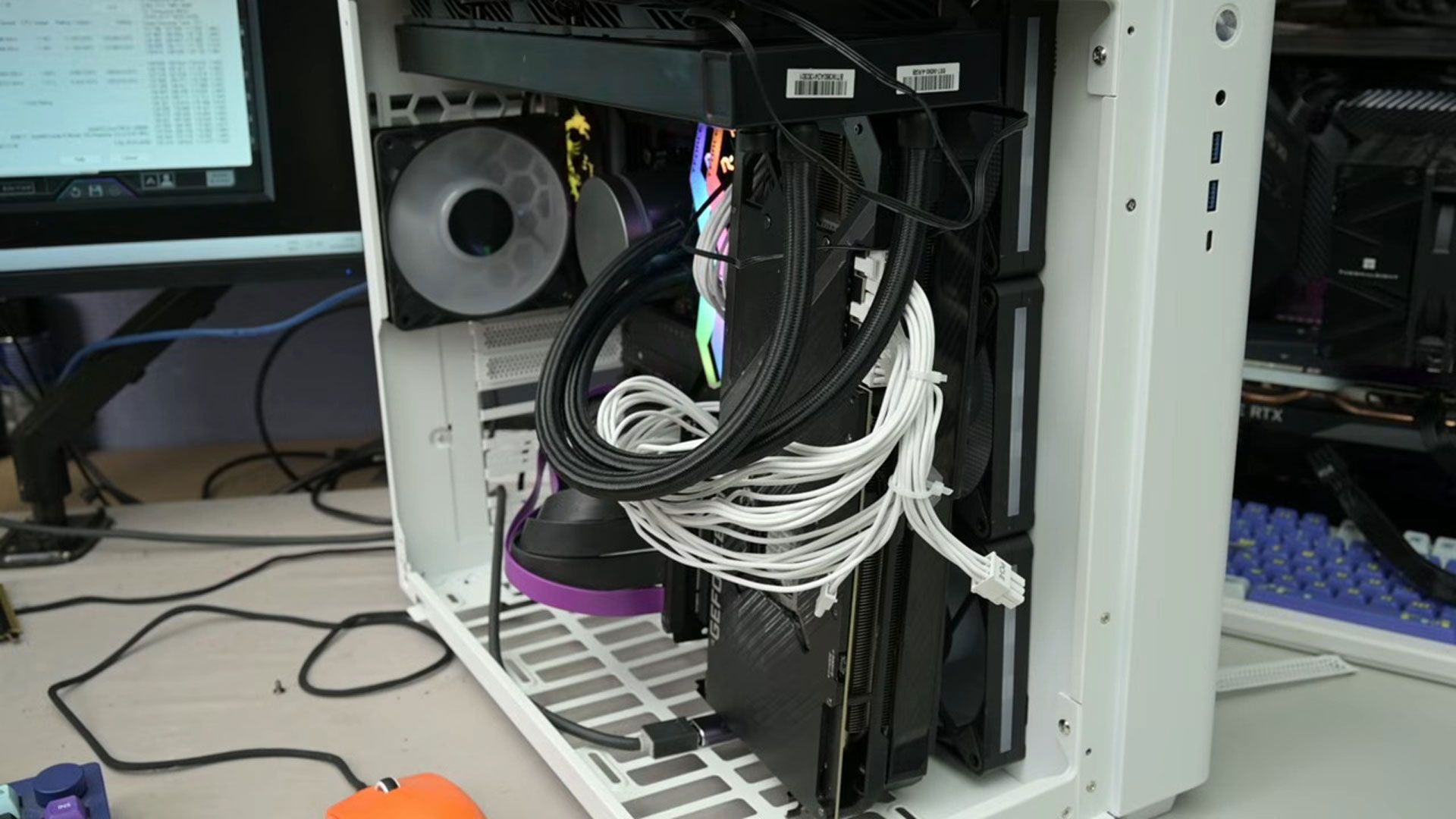
The result seems counterintuitive: a graphics card mounted where it normally wouldn't go records a hotspot temperature 19 degrees lower. This is not a detail for case-modding enthusiasts. At a time when inference for language models and other intensive workloads is moving to local hardware, hotspot temperature is one of the parameters that determines whether a system maintains boost frequencies or drops into throttling.
The number alone is not enough to rewrite the manuals, but it forces us to think about a structural point: GPU cooling does not depend only on the quality of the heatsink or the number of fans. Physical position relative to other cards, the case wall, and airflow can create heat pockets that average sensors do not always reveal. That is the value of this finding: the hotspot, which measures the hottest point on the die, is a stricter indicator than average temperature.
For those assembling or choosing self-hosted machines for LLMs, the implications are immediate. Inference and fine-tuning workloads tend to saturate the GPU for extended periods. If the chassis layout leaves a card in a stagnant zone, the system may appear stable in the first few minutes and then lose performance after hours of use. A 19-degree difference on the hotspot is not only about acoustic comfort: it can determine whether the GPU stays within the boost window or whether the firmware reduces frequencies.
It is worth looking at this from a TCO perspective. An on-premise system for local model inference is not evaluated only with peak benchmarks. Energy consumption under sustained load, hardware longevity, and performance predictability all matter. A thermal design that leaves headroom avoids later interventions, reduces noise, and keeps components in less stressful working conditions. It is not an aesthetic issue: it is a factor that affects operating cost. For those evaluating these trade-offs, AI-RADAR devotes space to on-premise analysis frameworks at /llm-onpremise.
The modder's case points to a design habit worth questioning. Many chassis and motherboards are born with a standard PCIe slot layout that favors compatibility, not necessarily optimal cooling. When multiple GPUs are mounted to increase aggregate VRAM or to parallelize inference, the space between cards becomes a scarce resource. Riser solutions or unconventional placements are often dismissed as modding choices, but they can offer concrete thermal advantages.
There is also a second-order effect for those selling ready-made systems. Vendors of on-premise AI machines have an incentive to differentiate themselves not only with the specs of the supported models, but also with the thermal quality of the design. An enterprise customer evaluating a fleet of LLM machines does not always have the chance to test behavior under load for weeks. The reputation of those who design efficient layouts becomes an asset, especially when workloads are continuous and noise in the office or lab is a constraint.
There is no need to exaggerate the scope of a single experiment, and the reported figure does not include details on the exact configuration. But it is enough to remind us that in local deployment of AI workloads, the mechanical side is not ancillary. It is the foundation on which purchasing decisions, rack sizing, and energy cost estimates rest. If an apparently irrational modification produces a hotspot 19 degrees cooler, the question to ask is not only 'how much is it worth in benchmarks', but 'how much are we losing because of standard layouts that no one has questioned'.







💬 Comments (0)
🔒 Log in or register to comment on articles.
No comments yet. Be the first to comment!