AI at the Apex of SAP's Strategy
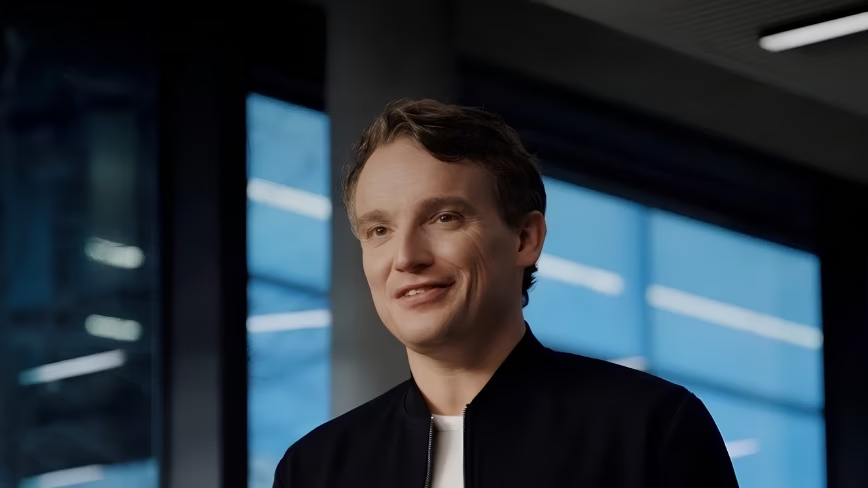
SAP, Europe's largest software company, has announced a significant internal reorganization. For the second time within a year, the company has redefined product and engineering responsibilities, with artificial intelligence (AI) emerging as the focal point of this restructuring. The most notable development is the direct assignment of AI product oversight to the CEO and COO, a move that underscores the strategic centrality of this technology for the German giant's future.
A Deliberate Strategic Move
When a company of such magnitude undertakes a high-level reorganization twice in a year, and in both instances AI is the dominant theme, it signals a clear, deliberate strategy rather than mere internal adjustments. Elevating AI oversight to the highest executive levels – CEO and COO – indicates a commitment to accelerate the development and integration of AI across all of SAP's offerings. This decision reflects the growing market pressure on software companies to deliver robust, scalable AI solutions capable of generating concrete value for enterprise customers.
Implications for Enterprise AI and Deployment
SAP's move is not an isolated incident but part of a broader trend where AI is transforming from an emerging technology into a fundamental component of business operations. For organizations evaluating the adoption of Large Language Models (LLM) and other AI solutions, decisions like SAP's highlight the importance of a well-defined AI strategy. This includes the choice of deployment model: on-premise, cloud, or hybrid. Data sovereignty, regulatory compliance (such as GDPR), and Total Cost of Ownership (TCO) are critical factors driving many companies to consider self-hosted or air-gapped solutions, especially in regulated sectors. The need for direct control over infrastructure and data, coupled with the necessity to optimize performance and latency for intensive AI workloads, makes on-premise deployment a strategic choice for many CTOs and infrastructure architects. For those evaluating on-premise deployments, AI-RADAR offers analytical frameworks on /llm-onpremise to assess the trade-offs between different options.
The Future of Enterprise Innovation
The centralization of AI at SAP's highest echelons is a significant indicator of the direction enterprise innovation is taking. Companies can no longer afford to treat AI as a secondary initiative; it must be integrated into the core of product and business strategy. This emphasis will require continuous investment in research and development, as well as in infrastructures capable of supporting inference and training of increasingly complex models. The ability to manage these workloads efficiently, securely, and in compliance with regulations will be a distinguishing factor in the future competitive landscape.









💬 Comments (0)
🔒 Log in or register to comment on articles.
No comments yet. Be the first to comment!