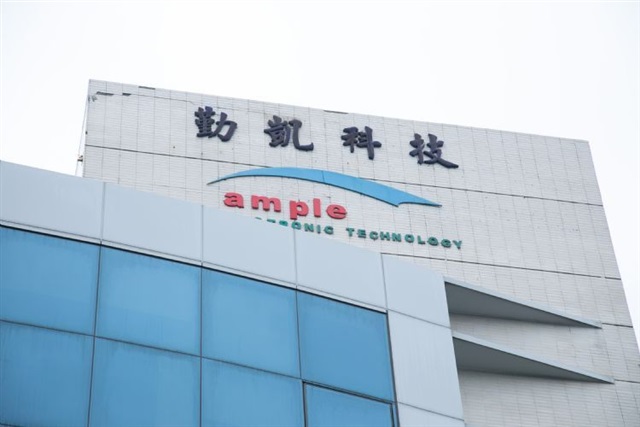
The Role of AI Servers in Ample Electronic's Growth
Ample Electronic, a key player in the electronics sector, is experiencing a period of remarkable expansion. As reported by DIGITIMES, this growth is primarily attributable to two converging factors: the increasing demand for dedicated artificial intelligence servers and the recovery of the Multi-Layer Ceramic Capacitor (MLCC) market. This scenario underscores the critical importance of underlying hardware for advancing AI capabilities, particularly for the intensive workloads associated with Large Language Models (LLM).
The surge in demand for AI servers reflects a broader trend in the technological landscape, where companies of all sizes seek to integrate AI capabilities into their operations. Whether for training complex models or performing large-scale Inference operations, the need for specialized computing power has become an imperative. These servers are the backbone upon which modern AI architectures rely, providing the parallel processing and high-speed memory indispensable for managing massive datasets and sophisticated algorithms.
The Importance of Passive Components in AI Infrastructure
In parallel with the push from AI servers, the recovery of the MLCC market plays a fundamental role in Ample Electronic's growth. Multi-Layer Ceramic Capacitors are essential passive components, present in almost all modern electronic devices. In the context of AI servers, MLCCs are crucial for power supply stability and signal integrity, especially for high-power components like GPUs. These capacitors help filter electrical noise and stabilize voltages, ensuring that Graphics Processing Units (GPUs) and other high-performance chips receive clean and constant power, which is indispensable for operating at maximum efficiency and reliability.
Their importance is amplified by the demanding nature of AI workloads. GPUs, for example, can require significant current peaks and complex thermal management. The quality and availability of MLCCs directly influence the performance and longevity of AI hardware. A recovery in this market segment not only indicates greater confidence in the electronic supply chain but also strengthened production capacity, essential for sustaining the expansion of AI infrastructure globally.
Implications for On-Premise LLM Deployments
For organizations considering on-premise LLM deployment, the availability and reliability of AI servers and their components are critical factors. Adopting a self-hosted infrastructure offers significant advantages in terms of data sovereignty, control over security, and potential optimization of Total Cost of Ownership (TCO) in the long run. However, it requires a considerable initial investment (CapEx) and careful infrastructure planning, including aspects such as power, cooling, and high-speed network connectivity.
The reliance on components like MLCCs highlights how the robustness of the entire hardware supply chain is crucial for the success of on-premise AI projects. Choosing servers with adequate specifications, such as sufficient VRAM for larger models or high throughput for Inference, is only part of the equation. The ability to procure and maintain these systems, while ensuring compliance with privacy regulations and data residency, becomes a distinguishing element for CTOs and infrastructure architects. For those evaluating on-premise deployments, AI-RADAR offers analytical frameworks on /llm-onpremise to assess specific trade-offs related to these choices.
A Look at the Artificial Intelligence Supply Chain
Ample Electronic's growth, driven by demand for AI servers and the recovery of MLCCs, offers an interesting insight into the dynamics of the artificial intelligence supply chain. As AI becomes increasingly pervasive, the reliance on a robust and resilient global supply chain intensifies. Disruptions or fluctuations in the availability of critical components can have a significant impact on lead times and costs for companies seeking to expand their AI capabilities.
This scenario underscores the importance for technology decision-makers to understand not only the technical specifications of AI hardware but also the market dynamics that influence its production and availability. The ability to anticipate supply chain trends and manage associated risks is fundamental to ensuring that AI deployment strategies, both on-premise and hybrid, can be successfully implemented and sustained over time.







💬 Comments (0)
🔒 Log in or register to comment on articles.
No comments yet. Be the first to comment!