
A Leadership Change for Apple
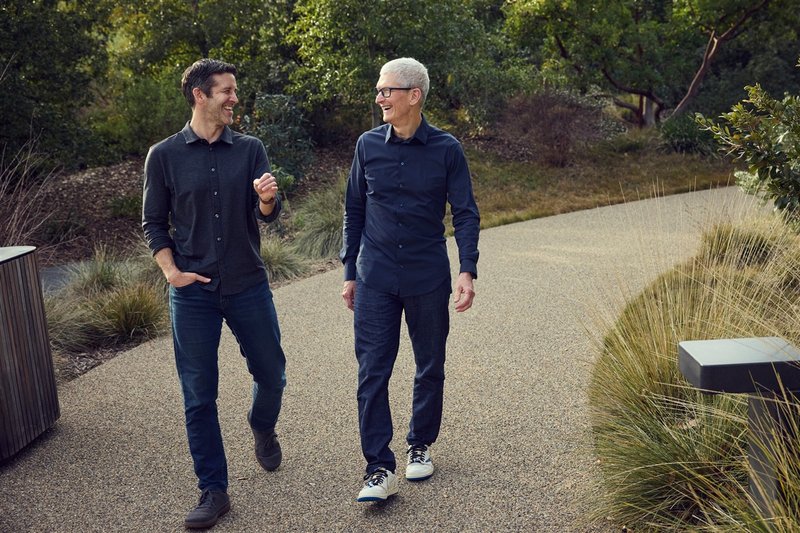
September 1st will mark a significant transition for Apple, with the announcement of Tim Cook's resignation as CEO after nearly fifteen years. His leadership saw the company achieve unprecedented financial milestones, transforming a market capitalization of $348 billion into approximately $4 trillion and quadrupling annual revenue to $416 billion.
This handover concludes an era of growth and consolidation for Apple. The designated successor is John Ternus, 50, current Senior Vice President of Hardware Engineering. His appointment reflects the strategic importance that the hardware sector continues to hold for the Cupertino giant, given that Ternus oversees products generating approximately 80% of the company's revenue.
Cook's Legacy and Ternus's Vision
Tim Cook's era was characterized by extraordinary financial expansion and optimization of global supply chains. Although he did not introduce revolutionary products like his predecessor, Cook successfully capitalized on and evolved the Apple ecosystem, leading the company to unimaginable heights.
The rise of John Ternus, with his deep background in hardware engineering, suggests a potential renewed emphasis on innovation and vertical integration of silicio. In an era where technological differentiation is increasingly linked to the ability to design and optimize proprietary chips, his leadership could further strengthen Apple's strategy in controlling the entire development pipeline, from chip design to the final product.
The Role of Custom Silicio in the AI Era
The decision to entrust Apple's leadership to a hardware expert highlights a broader trend in the tech industry: the growing importance of custom silicio, especially for workloads related to artificial intelligence and Large Language Models (LLM). Companies like Apple have invested heavily in developing proprietary chips, such as the M-series, to optimize the performance, energy efficiency, and security of their devices.
This vertical integration strategy, which involves direct control over processor design, is crucial for enabling advanced AI functionalities directly on devices or in controlled environments. For enterprises evaluating LLM deployment, the availability of specialized hardware, whether proprietary or third-party, is a decisive factor in meeting the throughput, latency, and VRAM requirements for inference and fine-tuning.
Implications for the Industry and Deployment Choices
The appointment of a leader with a strong hardware background in one of the world's most influential companies underscores the strategic value of underlying infrastructure in the AI era. For CTOs, DevOps leads, and infrastructure architects, this trend translates into critical decisions regarding the deployment of their AI workloads. The choice between cloud solutions and self-hosted approaches, such as bare metal or air-gapped environments, increasingly depends on the ability to optimize hardware for specific needs.
Factors such as data sovereignty, regulatory compliance, and Total Cost of Ownership (TCO) guide the evaluation of these alternatives. While the cloud offers scalability and flexibility, on-premise solutions can ensure tighter control over data and, for consistent workloads, a more advantageous TCO in the long term. AI-RADAR offers analytical frameworks on /llm-onpremise to evaluate these trade-offs, providing tools for informed decisions without direct recommendations.






💬 Comments (0)
🔒 Log in or register to comment on articles.
No comments yet. Be the first to comment!