Canva and its Expansion into AI Assistants
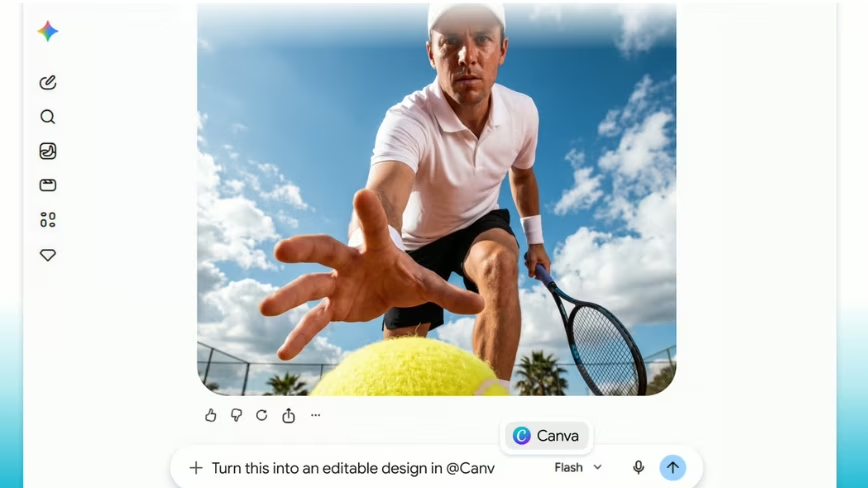
Canva, the graphic design platform, has announced a significant integration with Google Gemini, Google's artificial intelligence model. This move, unveiled during Google I/O, marks the completion of a strategy that has seen Canva position itself as a fundamental design layer within major AI assistants. The goal is to provide users with the ability to generate, edit, and search design elements directly through Gemini's conversational interface.
This integration with Gemini follows a path already established by Canva over the past year, which included similar collaborations with other key industry players. The platform has already extended its functionalities to Claude, ChatGPT, and Microsoft Copilot, demonstrating a clear strategic vision aimed at making its AI-powered design tools accessible across a wide range of operational and conversational contexts.
Implications for Enterprise Adoption and Data Management
The integration of design tools like Canva into commonly used AI assistants raises relevant questions for enterprises evaluating the adoption of these technologies. While ease of use and accessibility improve productivity, critical considerations regarding data sovereignty and compliance emerge. Companies must carefully assess how sensitive data, including design assets and information generated by LLMs, is managed and stored when using third-party services integrated into cloud ecosystems.
For organizations with stringent security requirements or specific regulations, the choice between cloud deployment and self-hosted solutions for the underlying LLMs becomes crucial. Even if Canva's user interface is cloud-based, interactions with AI assistants can involve data flows that require careful analysis. The ability to maintain control over data through on-premise or air-gapped deployments for the AI models processing requests is a determining factor for many CTOs and infrastructure architects.
Canva's Strategy: A Ubiquitous AI Design Ecosystem
Canva's strategy to integrate with major AI assistants reflects a broader trend in the tech industry: the convergence of productivity tools and artificial intelligence capabilities. By positioning itself as the "design layer" for these assistants, Canva aims to become an indispensable resource for visual content creation in any digital context. This approach not only expands its user base but also strengthens its competitive position in a rapidly evolving market.
This move highlights how companies are seeking to simplify workflows, allowing users to remain within a single environment to perform various tasks, from text generation to image creation. The challenge for technology providers and the companies adopting them will be to balance innovation and convenience with the need to maintain high standards of security, privacy, and control over their digital assets and proprietary information.
Future Prospects and AI Infrastructure Considerations
The evolution of platforms like Canva and their integration into AI assistants underscores the importance of robust and flexible AI infrastructure. While most of the mentioned AI assistants operate on cloud infrastructures, the growing demand for customization, data control, and cost optimization is pushing many enterprises to explore hybrid or fully on-premise deployment options for their LLM workloads. This includes evaluating specific hardware, such as GPUs with high VRAM, and orchestration solutions to manage inference and fine-tuning locally.
For those evaluating on-premise deployment, AI-RADAR offers analytical frameworks on /llm-onpremise to assess the trade-offs between TCO, data sovereignty, and performance requirements. The integration of AI design tools into broader ecosystems further highlights the need for a clear infrastructural strategy that can support both cloud-based applications and those requiring more granular local control, ensuring sensitive data remains within corporate boundaries or relevant jurisdictions.




💬 Comments (0)
🔒 Log in or register to comment on articles.
No comments yet. Be the first to comment!